Introduction to Solar Net Metering New Rules 2026
The Solar Net Metering New Rules 2026 have introduced a major shift in how solar electricity is calculated and credited in Pakistan. The federal government has updated the billing system to regulate excess electricity generated by consumers using solar panels. These changes directly affect households and businesses that rely on net metering for energy savings.
The new policy focuses on controlling unregulated solar expansion and ensuring stability in the national grid. As more people adopt solar energy, the government aims to create a balanced system where production and consumption remain within approved limits. This makes it important for solar users to fully understand the updated rules.
- New billing system introduced
- Focus on controlling excess electricity
- Applies to all net metering users
- Important for solar investment decisions
You Can Also Read: Vivo X300s Price and Specifications 2026 – Full Features, Camera, Battery, and Review
Solar Net Metering New Rules 2026 – Key Update
One of the biggest changes under the Solar Net Metering New Rules 2026 is the removal of relief on excess electricity. Previously, users could export additional units to the grid and receive credit on their bills. This benefit has now been removed for units generated beyond approved capacity.
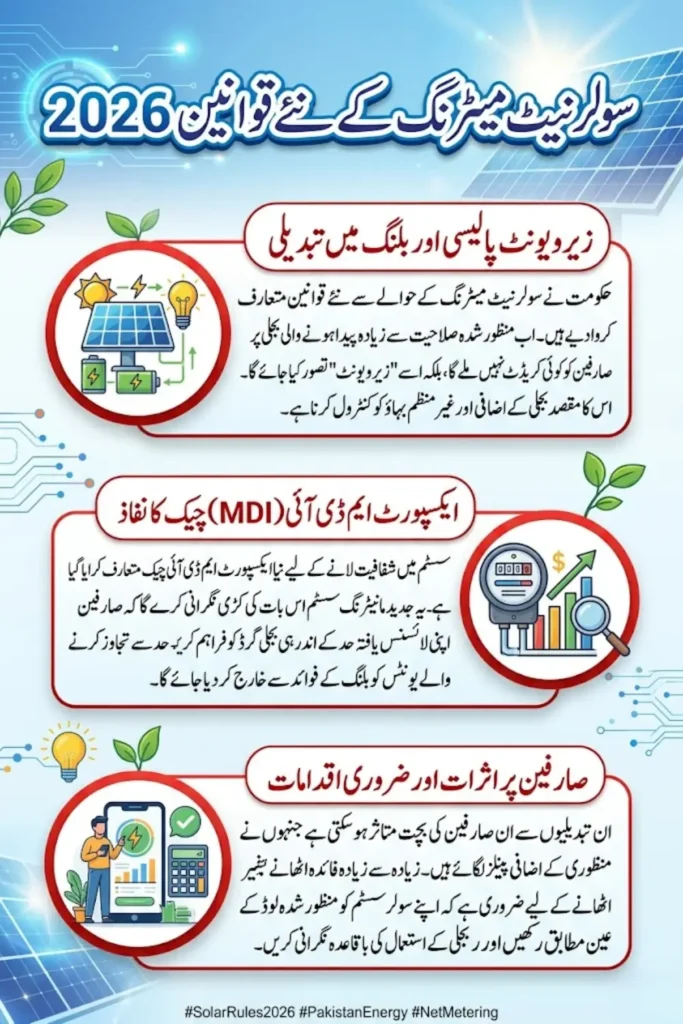
The government has implemented stricter monitoring mechanisms to ensure that consumers do not exceed their licensed limits. This policy shift is expected to bring more discipline to solar energy usage and prevent misuse of the system.
- No credit for extra electricity
- Strict monitoring introduced
- Focus on approved generation limits
- Major change in billing policy
What is Export MDI Check in Solar Net Metering New Rules 2026
The Export MDI (Maximum Demand Indicator) check is a new system introduced to monitor electricity export levels. It ensures that consumers only generate and export electricity within their approved capacity. Any production beyond this limit is identified through this mechanism.
This system works by tracking the maximum electricity demand and comparing it with the approved load. If a consumer exceeds the allowed limit, the excess units are flagged and excluded from billing benefits. This helps maintain fairness and control in the energy distribution system.
- Tracks maximum demand and export
- Prevents over-generation
- Ensures compliance with limits
- Improves billing accuracy
You Can Also Read: Jaecoo J7 vs Toyota Fortuner – Complete Comparison of Price, Specs, Features, Performance & SUV Value in Pakistan
Zero Unit Policy Under Solar Net Metering New Rules 2026
The zero unit policy is another important feature of the new rules. Under this system, any electricity generated beyond the approved limit is considered “zero units.” This means that such electricity will not be counted or credited in the consumer’s bill.
Distribution companies have been instructed to apply this rule strictly. As a result, consumers who install additional panels without approval will not receive any financial benefit for the extra electricity they produce.
- Excess electricity counted as zero
- No billing credit for extra units
- Strict enforcement by DISCOs
- Applies to all solar users
Impact of Solar Net Metering New Rules 2026 on Consumers
The Solar Net Metering New Rules 2026 have a direct financial impact on consumers. Many users who previously benefited from exporting extra electricity will now see reduced savings. This change affects the overall return on investment for solar systems.
At the same time, the rules encourage responsible usage and proper system sizing. Consumers will need to carefully plan their solar installations to avoid generating unused electricity that provides no financial return.
- Reduced savings for users
- Lower return on investment
- Need for proper system planning
- Increased awareness required
You Can Also Read: Jaecoo J7 vs Toyota Fortuner – Complete Comparison of Price, Specs
Who Will Be Affected by Solar Net Metering New Rules 2026
These new rules mainly affect consumers who have installed solar systems beyond their approved capacity. Users who add extra panels without updating their license will face the most impact under the zero unit policy.
Small system owners who stay within their limits may not experience significant changes. However, larger system owners and commercial users are more likely to be affected due to higher generation levels.
- Consumers with extra panels affected
- Large systems face more impact
- Small users less affected
- Applies across residential and commercial sectors
You Can Also Read: Solar Consumers New Electricity Charges in Pakistan 2026 Complete Guide to Net Metering, Rates and Savings
Approved Capacity vs Excess Generation
Understanding the difference between approved capacity and excess generation is crucial under the new rules. Approved capacity refers to the electricity generation limit set by authorities for each consumer.
Excess generation occurs when users produce more electricity than their approved limit. Under the new policy, this extra electricity does not provide any financial benefit, making it important to stay within limits.
| Category | Description |
|---|---|
| Approved Capacity | Licensed generation limit |
| Excess Generation | Production beyond approved limit |
| Billing Impact | No credit for excess units |
| Monitoring Tool | Export MDI Check |
- Approved capacity defines limit
- Excess generation gives no benefit
- Must follow licensed capacity
- Important for billing accuracy
Role of Distribution Companies (DISCOs)
Distribution companies play a key role in implementing the Solar Net Metering New Rules 2026. They have been instructed to monitor electricity generation and ensure compliance with the new policy.
These companies will update billing systems to reflect zero units for excess electricity. They are also responsible for enforcing the Export MDI check and ensuring accurate billing for all consumers.
- Monitor electricity usage
- Apply zero unit policy
- Update billing systems
- Ensure rule enforcement
You Can Also Read: Solar Consumers New Electricity Charges in Pakistan 2026 Complete Guide
Why Government Introduced Solar Net Metering New Rules 2026
The government introduced these rules to manage the rapid growth of solar energy in Pakistan. Uncontrolled expansion can create challenges for grid stability and energy distribution.
By limiting excess generation, the government aims to maintain balance in the power system. This policy also ensures that all consumers follow fair and regulated practices.
- Control unregulated growth
- Maintain grid stability
- Ensure fair usage
- Improve energy management
Financial Impact of Solar Net Metering New Rules 2026
The financial impact of these rules is significant for many solar users. Without credit for excess units, overall savings from solar systems may decrease. This could affect future investment decisions.
However, users who plan their systems correctly can still benefit from reduced electricity bills. Proper system sizing becomes more important than ever under the new policy.
- Reduced financial benefits
- Impact on investment planning
- Importance of system sizing
- Long-term cost considerations
You Can Also Read: CM Punjab Solar Panel Program 8800 Status Check Using Consumer ID – Complete Guide 2026
Pros and Cons of Solar Net Metering New Rules 2026
The new rules offer both advantages and disadvantages. While they improve system control and fairness, they also reduce incentives for solar users.
Understanding these pros and cons helps consumers make informed decisions about their energy usage and future investments.
| Pros | Cons |
|---|---|
| Better grid management | Reduced savings |
| Fair system usage | No credit for excess units |
| Improved monitoring | Lower ROI for users |
| Controlled expansion | Impact on solar adoption |
- Balanced policy approach
- Benefits for grid stability
- Challenges for users
- Important for long-term planning
What Solar Consumers Should Do Now
Solar users should adjust their systems according to the new rules. It is important to ensure that the installed capacity matches the approved limit to avoid losses.
Regular monitoring of electricity usage and billing is also necessary. Consumers should stay informed about policy updates and follow official guidelines.
- Stay within approved limits
- Avoid installing extra panels
- Monitor electricity usage
- Follow official guidelines
You Can Also Read: Ration Card Payment Check 2026: Complete Guide to CM Punjab Ration Card Status
Future of Solar Energy After New Rules 2026
The Solar Net Metering New Rules 2026 may influence the future growth of solar energy in Pakistan. While they introduce restrictions, they also create a more structured system for energy management.
In the long term, these rules could lead to better planning and sustainable growth in the solar sector. Future policies may further refine the system to balance user benefits and grid stability.
- Structured solar growth
- Improved regulation
- Possible future updates
- Long-term sustainability
Final Thoughts on Solar Net Metering New Rules 2026
The Solar Net Metering New Rules 2026 mark a significant change in Pakistan’s energy policy. By removing credit for excess electricity and introducing the Export MDI check, the government aims to create a fair and controlled system.
Consumers must understand these changes and adjust their solar usage accordingly. Staying informed and planning carefully will help users continue to benefit from solar energy despite the new limitations.
You Can Also Read: Jaecoo J5 Price in Pakistan 2026 – Full Specs, Features, and Hybrid SUV Review
FAQs
What are Solar Net Metering New Rules 2026?
These rules remove credit for excess electricity and introduce Export MDI checks to control generation limits.
What is the zero unit policy in net metering?
It means extra electricity beyond approved limits will not be counted or credited in billing.
Who is affected by these new rules?
Consumers who generate more electricity than their approved capacity are directly affected.
Can I still benefit from solar panels after these rules?
Yes, you can still save on bills if your system stays within the approved capacity.
You Can Also Read: Vivo X300s Price and Specifications 2026 – Full Features