
HEC New Admissions Policy Makes GRE and HAT Tests Mandatory for MS and MPhil Programs
HEC New Admissions Policy
The Higher Education Commission has introduced the HEC New Admissions Policy to standardize admissions for MS and MPhil programs across Pakistan. Under the revised policy, students applying for Level 7 and Level 8 degree programs will now be required to pass either the GRE or HAT General and Subject tests. The new framework is designed to improve transparency, merit, and quality assurance in higher education admissions nationwide.
According to the official notification, universities will no longer be allowed to conduct separate entry tests for admissions to MS and MPhil programs. The HEC believes that a centralized testing system will help create equal opportunities for students and strengthen the overall admission process. Alongside these changes, the Pakistan Medical and Dental Council has also introduced revised guidelines for medical students applying to local and foreign medical institutions.
You Can Also Read: 700 Million E Learn She Earn Program Digital Skills Free Training and Free Laptops Know How to Apply
What is the HEC New Admissions Policy?
The HEC New Admissions Policy is a revised admission framework introduced for postgraduate education in Pakistan. Under this policy, students seeking admission to MS and MPhil programs must qualify through standardized tests such as GRE or HAT. The Higher Education Commission aims to replace separate university entry tests with a unified testing system that applies nationwide.
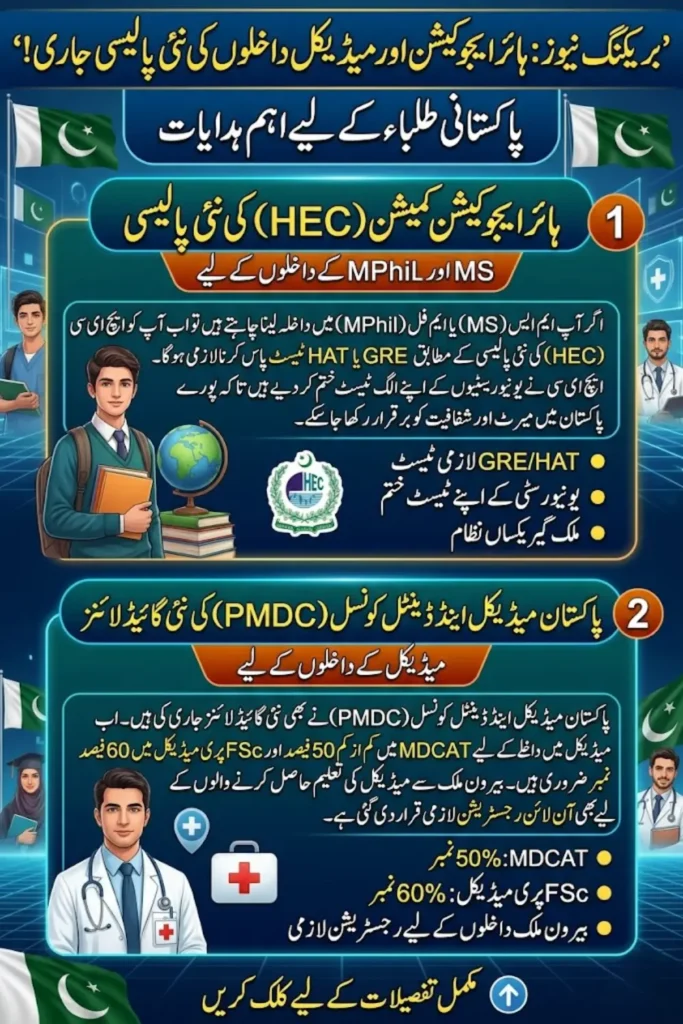
Officials believe the policy will improve the fairness and credibility of the admission process. By implementing one standardized testing mechanism, universities will follow the same evaluation criteria for all applicants. The new system is expected to reduce inconsistencies and strengthen merit-based admissions.
Key objectives of the policy include:
- Improving transparency in admissions
- Standardizing postgraduate entry requirements
- Promoting merit-based selection
- Strengthening quality assurance
- Creating uniform admission procedures nationwide
GRE and HAT Tests Under the HEC New Admissions Policy
Under the HEC New Admissions Policy, students applying to Level 7 and Level 8 degree programs will need to pass either the GRE or HAT tests. These examinations will now serve as the primary assessment tools for admission eligibility in universities across Pakistan. The policy applies to both general and subject-specific postgraduate programs.
The HAT General and Subject tests are designed to evaluate students’ analytical, academic, and subject knowledge. The Higher Education Commission believes that standardized testing will improve the quality of student selection and ensure that admissions are granted fairly based on performance.
Accepted tests under the policy include:
- GRE General Test
- GRE Subject Test
- HAT General Test
- HAT Subject Test
You Can Also Read: WhatsApp Incognito Mode Lets Users Hold Private Meta AI Conversations
| Test Name | Purpose |
|---|---|
| GRE General | Evaluates analytical and reasoning skills |
| GRE Subject | Assesses subject-specific knowledge |
| HAT General | Measures academic aptitude |
| HAT Subject | Evaluates specialized academic skills |
Universities Will No Longer Conduct Separate Entry Tests
One of the biggest changes under the HEC New Admissions Policy is the restriction on separate university entry tests for MS and MPhil admissions. Universities will now rely entirely on GRE and HAT examinations for evaluating applicants. This decision is expected to simplify the admission process for students applying to multiple institutions.
The centralized testing system may also reduce confusion and unnecessary financial burden on students who previously had to appear in multiple university-specific exams. The HEC believes that a single standardized process will improve fairness and create consistency across higher education institutions.
Benefits of centralized testing include:
- Uniform admission standards
- Reduced admission irregularities
- Easier application process for students
- Greater transparency in evaluations
- Equal opportunities nationwide
You Can Also Read: Private Schools in Islamabad Face Crackdown Over Illegal Fees and Unregistered Operations
Purpose Behind the HEC New Admissions Policy
The HEC New Admissions Policy has been introduced to strengthen the overall higher education system in Pakistan. According to officials, the policy focuses on improving standardization, transparency, merit, and quality assurance in university admissions. Authorities believe centralized testing will help improve academic standards and ensure that deserving students are selected fairly.
The commission also aims to establish a more reliable admission framework that supports long-term educational reforms. Standardized admission systems are commonly used internationally, and HEC officials believe adopting similar methods can improve the reputation and credibility of Pakistani universities.
Main goals of the policy include:
- Promoting academic excellence
- Strengthening merit-based admissions
- Enhancing transparency
- Improving university admission quality
- Creating nationwide uniformity
PMDC Revised Guidelines for Medical Students
Alongside the HEC New Admissions Policy, the Pakistan Medical and Dental Council has also issued revised guidelines for students applying to medical institutions. Under the updated rules, students must secure at least 50% marks in the MDCAT examination or an equivalent foreign test to qualify for admissions.
In addition, applicants are required to complete FSc Pre-Medical or an equivalent qualification with a minimum of 60% marks. The PMDC explained that these updated criteria are aimed at maintaining educational standards and improving the quality of medical education in Pakistan.
Updated PMDC requirements include:
- Minimum 50% marks in MDCAT
- Equivalent foreign test acceptance
- Minimum 60% marks in FSc Pre-Medical
- Compliance with PMDC admission rules
You Can Also Read: Scholarships in Germany Without IELTS for International Students 2026
| Admission Requirement | Minimum Criteria |
|---|---|
| MDCAT Examination | 50% Marks |
| FSc Pre-Medical | 60% Marks |
| Equivalent Qualification | Accepted by PMDC |
PMDC Rules for Foreign Medical Admissions
The PMDC has also directed students seeking admission to foreign medical institutions to complete online registration procedures before beginning their studies abroad. Students must apply for provisional registration and complete National Registration Examination requirements according to official guidelines.
The council advised applicants to carefully follow all admission regulations and regularly check the official PMDC website for updated instructions. Authorities believe these measures will help maintain professional standards and ensure proper registration of Pakistani medical students studying overseas.
Important PMDC registration requirements include:
- Online provisional registration
- National Registration Examination process
- Verification of foreign institutions
- Compliance with PMDC regulations
Impact of the HEC New Admissions Policy on Students
The HEC New Admissions Policy is expected to create significant changes for students applying to postgraduate programs. Applicants will now need to prepare for GRE or HAT tests instead of separate university entry exams. This may increase competition because all candidates will be evaluated through standardized assessments.
At the same time, the policy may benefit students by reducing the stress of appearing in multiple entry tests. A centralized system can help students save time and application expenses while ensuring equal admission standards across universities.
Expected impacts on students include:
- Increased competition in admissions
- Greater focus on standardized testing
- Reduced need for multiple entry exams
- Easier admission application process
- Improved merit-based opportunities
You Can Also Read: FBR AI-Based Asset Monitoring System for Government Officers in Pakistan
Challenges Associated with the New Policy
Although the policy offers several advantages, students and universities may face adjustment challenges during the implementation phase. Some students may require additional preparation for GRE or HAT examinations, especially those unfamiliar with standardized testing formats.
Universities will also need to align their admission procedures with HEC regulations and ensure smooth implementation of the centralized testing framework. Proper awareness campaigns and guidance for students may become necessary to avoid confusion during the transition period.
Potential challenges include:
- Student preparation difficulties
- Transition from university-specific exams
- Awareness regarding new rules
- Increased pressure on applicants
- Administrative adjustments for universities
Final Thoughts
The HEC New Admissions Policy represents a major shift in postgraduate admissions across Pakistan. By making GRE and HAT tests mandatory for MS and MPhil programs, the Higher Education Commission aims to improve transparency, merit, and quality assurance in higher education institutions nationwide.
At the same time, the revised PMDC guidelines for medical students highlight the government’s broader efforts to strengthen educational standards and standardize admission procedures. The success of these reforms will largely depend on effective implementation, student awareness, and cooperation between universities and regulatory authorities.
You Can Also Read: Lahore Eid ul Adha Cattle Market Prices Rise Sharply Before Eid 2026
FAQs
1. What is the HEC New Admissions Policy?
The HEC New Admissions Policy introduces mandatory GRE or HAT tests for MS and MPhil admissions across Pakistan.
2. Are universities still allowed to conduct separate entry tests?
No, universities will no longer be permitted to conduct separate admission tests for MS and MPhil programs.
3. Which tests are accepted under the new HEC policy?
Students can apply using GRE General, GRE Subject, HAT General, or HAT Subject test scores.
4. What are the new PMDC admission requirements?
Students must secure at least 50% marks in MDCAT and 60% marks in FSc Pre-Medical or equivalent qualifications.
5. What must students do before studying medicine abroad?
Students must complete provisional registration and National Registration Examination requirements through the PMDC online system.
You Can Also Read: PM Shehbaz Directs Banks to Improve SME Financing in Pakistan and Support Women Entrepreneurs