
PM Youth Programme Gilgit-Baltistan to Train 1,000 Youth in IT and AI
PM Youth Programme Gilgit-Baltistan
Prime Minister’s Youth Programme is being expanded to Gilgit-Baltistan as the federal government plans to provide modern technology training to young people in the region. Under the programme, between 500 and 1,000 youth will receive training in information technology, artificial intelligence, cloud computing, and cybersecurity. The initiative reflects the government’s growing focus on digital education and technology-based employment opportunities.
The decision was discussed during a meeting in Islamabad between Ghulam Abbas and Rana Mashhood Ahmed Khan. Both sides reviewed plans to extend the NAVTTC–Huawei Prime Minister’s Youth Skill Development Programme to Gilgit-Baltistan. Officials believe the initiative can help bridge the technology skills gap and create better career opportunities for youth living in remote areas.
You Can Also Read: Mera Ghar Mera Ashiana Eligibility Criteria 2026 Complete Guide for Home Loan Applicants
PM Youth Programme Gilgit-Baltistan Expansion Begins
The expansion of the PM Youth Programme Gilgit-Baltistan is expected to improve access to modern technology education in the region. Government officials stated that Gilgit-Baltistan holds significant importance in the national youth development strategy, and digital skills initiatives will now be implemented there on a priority basis.
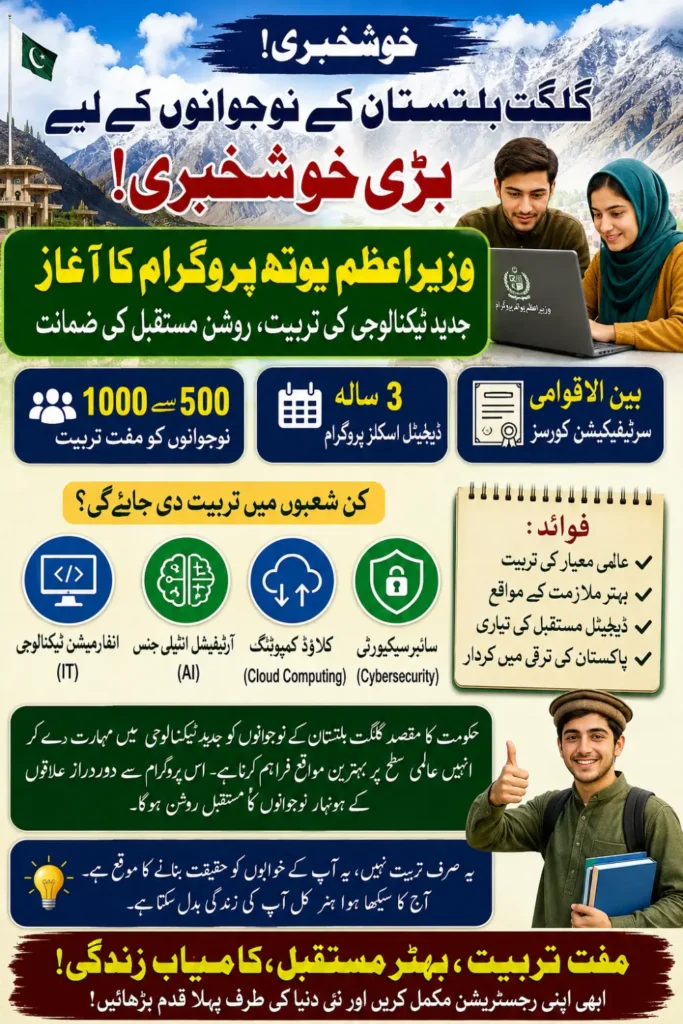
During the meeting, proposals were submitted to include Gilgit-Baltistan youth in Huawei-certified international training programmes. The initiative is designed to help students and graduates gain internationally recognized skills that can improve their chances of securing employment in global digital markets.
- Government plans to train 500 to 1,000 youth
- Training will focus on IT and emerging technologies
- Huawei-certified courses are part of the programme
- Gilgit-Baltistan will receive priority under PMYP
- International employability is a major objective
| Programme Area | Focus |
|---|---|
| Information Technology | Digital skills development |
| Artificial Intelligence | Emerging technology training |
| Cloud Computing | International certification |
| Cybersecurity | Modern IT security skills |
Technology Training Opportunities for Gilgit-Baltistan Youth
Youth in Gilgit-Baltistan often face difficulties in accessing advanced educational facilities because of geographical barriers and limited institutional infrastructure. Many talented students are unable to participate in quality IT programmes due to the lack of local training centers and modern digital resources.
The PM Youth Programme Gilgit-Baltistan aims to address these challenges by providing structured training opportunities in internationally recognized technologies. Officials believe that introducing advanced digital education in the region can help young people compete in global technology markets and support long-term economic development.
- Geographic barriers limit educational access
- Digital infrastructure remains underdeveloped
- Modern IT training can improve employability
- International certifications may create new opportunities
- Youth participation in technology fields is expected to increase
You Can Also Read: Apna Khet Apna Rozgar Scheme Apply Online 2026 Complete Guide for Punjab Farmers
Dedicated High-Tech Digital Skills Programme Proposed
The meeting also included discussions about launching a dedicated Gilgit-Baltistan High-Tech Digital Skills Programme. Under the proposal, more than 2,500 young people could receive internationally recognized IT and digital skills training over the next three years.
Officials believe this long-term initiative can strengthen the region’s technology ecosystem and prepare youth for future careers in advanced digital industries. The programme is expected to focus on practical skills that match current international market demands in areas like AI, cybersecurity, and cloud services.
- More than 2,500 youth may receive training
- Three-year digital skills programme is under consideration
- International IT standards will guide training modules
- AI and cybersecurity remain key focus areas
- Long-term digital transformation is expected
Pakistan Introduces National Skill Competency Test
The Government of Pakistan has also introduced the National Skill Competency Test (NSCT) for IT graduates. The initiative aims to reduce the gap between academic education and industry requirements in Pakistan’s growing information technology sector.
Officials stated that although Pakistan produces thousands of ICT graduates every year, inconsistent skill standards have limited employer confidence and slowed the growth of high-value IT exports. The NSCT was designed to create a standardized assessment system that measures graduates according to industry-aligned competencies.
- NSCT focuses on IT graduate assessment
- The initiative supports industry-academia collaboration
- Standardized testing improves credibility
- Technical competency evaluation remains the core objective
- IT export growth is a long-term target
You Can Also Read: How to Check Electricity Bill Relief & Subsidy in Pakistan 2026 – Complete Online Guide
| NSCT 2026 Statistics | Details |
|---|---|
| Participating Universities | More than 190 |
| Cities Covered | 112 |
| Examination Centers | 165 |
| Registered Students | 40,784 |
| Appeared Candidates | 33,038 |
NSCT 2026 Conducted Across Pakistan
According to official details, the NSCT was successfully conducted in April 2026 through the Virtual University platform. The examination took place simultaneously across Pakistan using a synchronized computer-based testing system designed to ensure transparency and fairness.
The assessment included 100 questions with a duration of 120 minutes. Tests were conducted in four daily sessions between 9:00 AM and 4:30 PM. Monitoring arrangements involved multiple organizations, including HEC, MoITT, PAS, and P@SHA, ensuring credibility and accurate evaluation standards.
- Computer-based exams were conducted nationwide
- Four daily testing sessions were arranged
- Exams included 100 technical questions
- Monitoring involved multiple government organizations
- Third-party validation improved transparency
You Can Also Read: Honda Atlas Pakistan MY26 Profit Rises 19% Despite Higher Finance Costs
Impact on Pakistan’s IT Sector and Digital Economy
The PM Youth Programme Gilgit-Baltistan and NSCT initiatives are expected to strengthen Pakistan’s digital economy by creating a more skilled IT workforce. Officials believe these programmes can improve the global reputation of Pakistani IT professionals and support higher participation in advanced technology fields.

The initiatives may also increase Pakistan’s capacity in artificial intelligence, cybersecurity, cloud computing, and data science. Improved technical education and competency-based evaluation systems could help the country expand IT exports and strengthen its position in international technology markets.
- IT workforce quality may improve significantly
- AI and cloud computing sectors may expand
- International confidence in Pakistani talent could increase
- Digital economy growth may accelerate
- IT exports may benefit from skilled professionals
Future Outlook for PM Youth Programme Gilgit-Baltistan
The future outlook for the PM Youth Programme Gilgit-Baltistan appears positive as the government continues focusing on technology-driven youth development. Expansion of digital skills programmes into remote regions may create more equal educational opportunities and support long-term economic inclusion.
As technology becomes increasingly important in global employment markets, initiatives like these can help Pakistan prepare its youth for future challenges. Greater investment in IT education, certifications, and industry collaboration is expected to play a major role in the country’s digital transformation strategy.
- More digital programmes may launch nationwide
- Remote regions could receive increased support
- Technology education remains a national priority
- Youth employment opportunities may improve
- Pakistan’s digital transformation could accelerate
You Can Also Read: GAC Motor Pakistan Entry Could Transform the Country’s Auto Industry
Conclusion
The PM Youth Programme Gilgit-Baltistan marks an important step toward improving technology education and digital skills development in remote regions of Pakistan. By offering training in AI, cloud computing, cybersecurity, and IT, the government aims to prepare youth for modern employment opportunities.
At the same time, the introduction of the National Skill Competency Test highlights Pakistan’s efforts to improve IT education standards and strengthen industry confidence. Together, these initiatives may support long-term digital growth, improve employability, and contribute to the expansion of Pakistan’s technology sector.
FAQs
What is the PM Youth Programme Gilgit-Baltistan initiative?
It is a government programme designed to train youth in Gilgit-Baltistan in IT, AI, cloud computing, and cybersecurity.
How many youth will receive training under the programme?
The government plans to train between 500 and 1,000 young people from Gilgit-Baltistan initially.
What is the purpose of the National Skill Competency Test?
The NSCT was introduced to evaluate IT graduates according to industry-based technical skill standards.
Which technologies are included in the training programmes?
The programmes focus on artificial intelligence, cybersecurity, cloud computing, and modern information technology skills.
How can these initiatives help Pakistan’s IT sector?
They can improve employability, strengthen IT exports, and increase international confidence in Pakistani technology professionals.
You Can Also Read: MG4 EV Urban Pakistan Launch Price, Features, Battery Range, and Specifications Revealed