
FBR Tax Revenue Loss: Early Market Shutdowns Cost Pakistan Rs. 20 Billion
FBR Tax Revenue Loss
The issue of FBR tax revenue loss has become a major concern as Pakistan faces economic pressure and declining business activity. Recent developments show that early market closures across different cities are reducing commercial operations, which directly impacts tax collection. This situation is creating a gap between expected and actual revenue at a critical time.
FBR Tax Revenue Loss 2026 Latest Update: Pakistan’s tax collection faces growing pressure as early market closures, rising fuel prices, inflation, and energy shortages continue to reduce business activity. According to recent estimates, the FBR may face a revenue shortfall of up to Rs. 20 billion, making it harder to achieve tax targets and increasing reliance on government borrowing.
Economic challenges such as inflation, rising costs, and reduced consumer spending are making it harder for authorities to maintain stable tax inflows. As a result, the Federal Board of Revenue is struggling to meet its targets, raising concerns about the overall fiscal outlook of the country.
- Early market closures are reducing trading hours
- Lower economic activity is impacting tax collection
- Revenue targets are becoming difficult to achieve
You Can Also Read: Wazir-e-Azam Apna Ghar Program 2026 – Latest Housing Scheme Update in Pakistan
FBR Tax Revenue Loss Due to Early Market Shutdowns
The FBR tax revenue loss caused by early market shutdowns is estimated to be between Rs. 15 billion and Rs. 20 billion. Businesses closing earlier than usual are generating fewer sales, which leads to a direct decline in taxable transactions. This reduction is affecting both direct and indirect tax streams.
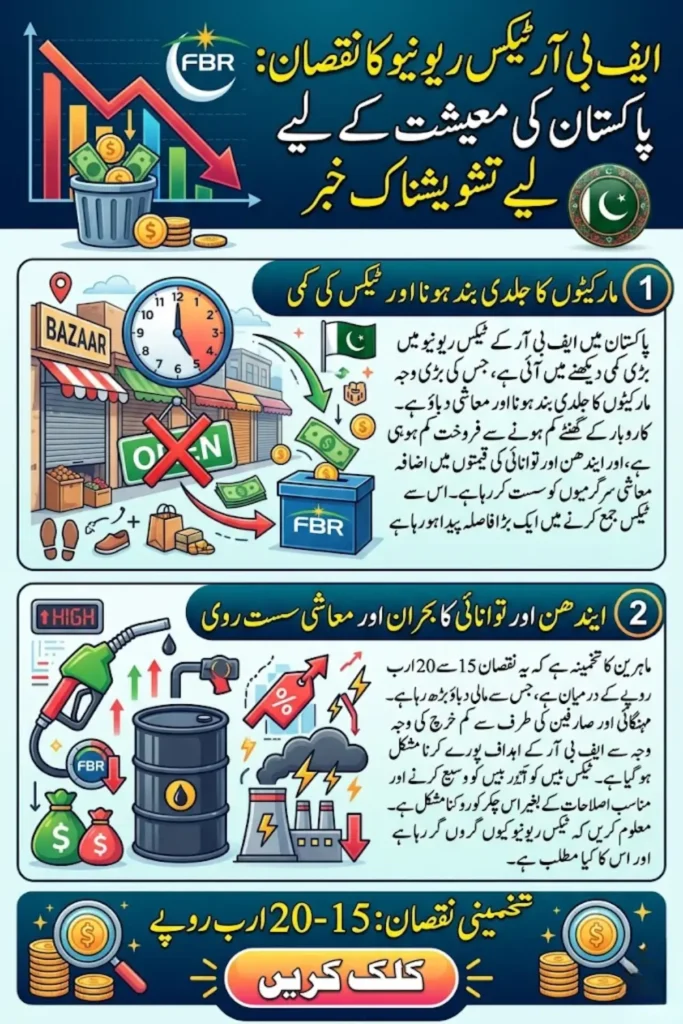
Shortened business hours limit customer interactions and reduce overall market activity. As fewer transactions take place, the amount of tax collected decreases, creating additional pressure on the national revenue system.
- Estimated loss ranges from Rs. 15–20 billion
- Shorter business hours reduce sales volume
- Decline in transactions affects tax generation
Economic Factors Behind FBR Tax Revenue Loss
Several economic factors are contributing to the ongoing FBR tax revenue loss. One of the main reasons is the steady increase in fuel prices, which has raised operational costs for businesses. This increase is forcing traders to cut down working hours to manage expenses.
In addition, inflation is reducing the purchasing power of consumers. When people spend less, businesses earn less revenue, and the government collects less tax, creating a cycle of economic slowdown.
- Rising fuel prices increase operational costs
- Inflation reduces consumer purchasing power
- Lower spending leads to reduced tax collection
You Can Also Read: AI Marketing Industry Growth: How Artificial Intelligence is Driving an $82 Billion Market by 2030
Impact of Petroleum Price Increase on FBR Tax Revenue Loss
The sharp rise in petroleum prices has significantly contributed to FBR tax revenue loss. Fuel prices have increased by around 42 percent, which has affected transportation and logistics costs across the country. Businesses are facing higher expenses just to maintain daily operations.
As a result, companies are either reducing production or limiting their working hours. This leads to fewer goods being sold and lower income generation, ultimately reducing the amount of tax collected by the government.
| Factor | Impact on Economy | Effect on Tax Revenue |
|---|---|---|
| Fuel Price Increase | Higher costs | Reduced profitability |
| Transportation Costs | Expensive logistics | Lower sales volume |
| Business Expenses | Increased overhead | Decreased tax income |
- Fuel prices increased by around 42 percent
- Transportation and logistics costs have risen
- Businesses are limiting operations to control expenses
You Can Also Read: Punjab Rahmat Card Program: How to Apply for Rs. 1 Lac Financial Assistance in 2026
Energy Crisis and Its Role in FBR Tax Revenue Loss
Energy shortages are another major factor behind FBR tax revenue loss. Disruptions in RLNG and furnace oil supplies are creating uncertainty in power availability. This has increased the risk of load shedding in major cities, including Islamabad.
Due to unreliable power supply, businesses are unable to operate at full capacity. Many traders are closing markets earlier to avoid losses, which further reduces commercial activity and tax generation.
- RLNG and furnace oil shortages affect energy supply
- Increased risk of load shedding in major cities
- Businesses reduce working hours due to power issues
Decline in Business Activity and Tax Collection
The decline in business activity is directly linked to FBR tax revenue loss. As operational costs rise and demand falls, businesses are experiencing lower sales. This reduction in turnover is weakening the overall tax base.
Retail markets are particularly affected, as reduced customer spending leads to lower daily earnings. When businesses generate less income, the amount of income tax collected also declines.
- Reduced retail activity lowers daily sales
- Declining turnover impacts tax collection
- Income tax revenues are weakening
You Can Also Read: HUBC BYD Project Profit Decline 2026 – Earnings Drop 99.8% and Investment Insights
Challenges Faced by FBR in Meeting Tax Targets
The Federal Board of Revenue is facing serious challenges in achieving its tax targets. Despite implementing new taxation measures, revenue collection remains below expectations. This indicates underlying structural issues in the tax system.
The gap between projected and actual revenue continues to widen due to economic slowdown and reduced business activity. These challenges highlight the need for improved tax policies and enforcement mechanisms.
| Challenge | Description | Impact |
|---|---|---|
| Revenue Shortfall | Targets not met | Fiscal pressure |
| Weak Enforcement | Limited compliance | Lower collections |
| Economic Slowdown | Reduced activity | Declining tax inflow |
- Revenue targets are consistently missed
- Enforcement issues limit tax collection
- Economic slowdown adds further pressure
You Can Also Read: NHMP Cashless Driving License Fee System Pakistan – Digital Payment System for Easy License Processing
Government and Parliamentary Concerns Over FBR Tax Revenue Loss
Lawmakers have raised concerns over the increasing FBR tax revenue loss and repeated shortfalls. Members of the finance committee questioned officials about the reasons behind weak performance despite introducing new tax measures.
There is growing concern that insufficient tax enforcement is forcing the government to rely heavily on borrowing. This reliance increases financial pressure and limits economic stability.
- Lawmakers are questioning tax performance
- Weak enforcement is a major concern
- Increased borrowing is affecting the economy
Role of Inflation in FBR Tax Revenue Loss
Inflation is playing a key role in driving FBR tax revenue loss. Rising prices are increasing the cost of imports, production, and daily expenses. This reduces both business profitability and consumer spending.
As economic uncertainty grows, businesses become cautious and limit expansion. This slowdown in economic activity directly reduces tax inflows and affects overall revenue generation.
- Inflation increases costs across sectors
- Businesses limit growth due to uncertainty
- Reduced activity lowers tax collection
You Can Also Read: FBR Revenue Loss 2026 Pakistan – Early Market Closures and Energy Crisis Impact Tax Collection
Dependence on Borrowing Due to FBR Tax Revenue Loss
Due to ongoing FBR tax revenue loss, the government is increasingly relying on borrowing to meet financial needs. When tax collection falls short, loans become necessary to cover budget deficits and maintain public spending.
However, excessive borrowing can create long-term economic challenges. It increases debt levels and puts additional pressure on future financial planning.
- Revenue shortfalls lead to borrowing
- Increased debt creates financial pressure
- Long-term economic risks are rising
You Can Also Read: Wazir-e-Azam Apna Ghar Program 2026 – Latest Housing Scheme Update in Pakistan
Recommendations to Address FBR Tax Revenue Loss
Experts and policymakers have suggested several measures to address FBR tax revenue loss. Expanding the tax base is considered essential to bring more individuals and businesses into the formal system.
Improving enforcement and reducing reliance on indirect taxes are also key recommendations. These steps can help create a more balanced and sustainable tax system.
- Expand the tax base for better coverage
- Strengthen enforcement mechanisms
- Reduce dependence on indirect taxation
Future Outlook of FBR Tax Revenue Loss in Pakistan
The future outlook of FBR tax revenue loss remains uncertain due to ongoing economic challenges. Factors such as inflation, energy shortages, and reduced business activity are expected to continue affecting tax collection.
However, with proper reforms and improved policies, there is potential to stabilize the situation. Strengthening the tax system and supporting economic growth can help improve revenue performance over time.
- Economic challenges may continue in short term
- Policy reforms can improve tax collection
- Long-term stability depends on structural changes
You Can Also Read: AI Marketing Industry Growth: How Artificial Intelligence is Driving an $82 Billion Market by 2030
Conclusion
FBR tax revenue loss is a complex issue driven by multiple economic factors, including early market closures, rising fuel prices, and energy shortages. These challenges are reducing business activity and weakening tax collection across the country.
Addressing this issue requires a combination of policy reforms, better enforcement, and economic stability. With the right measures, Pakistan can improve its revenue system and reduce dependence on borrowing.
FAQs
What is causing FBR tax revenue loss in Pakistan?
Early market closures, rising fuel prices, and energy shortages are the main causes of declining tax revenue.
How much revenue loss is expected due to market shutdowns?
The estimated loss is between Rs. 15 billion and Rs. 20 billion.
How do fuel prices affect tax revenue?
Higher fuel costs increase business expenses, reduce sales, and lower taxable income.
Why is FBR struggling to meet tax targets?
Economic slowdown, weak enforcement, and reduced business activity are key reasons.
What solutions can reduce tax revenue loss?
Expanding the tax base, improving enforcement, and implementing structural reforms can help.
You Can Also Read: Punjab Rahmat Card Program: How to Apply for Rs. 1 Lac Financial Assistance in 2026
Source: FBR GOV PK