

Pakistan State-Owned Enterprises Losses 2024-25
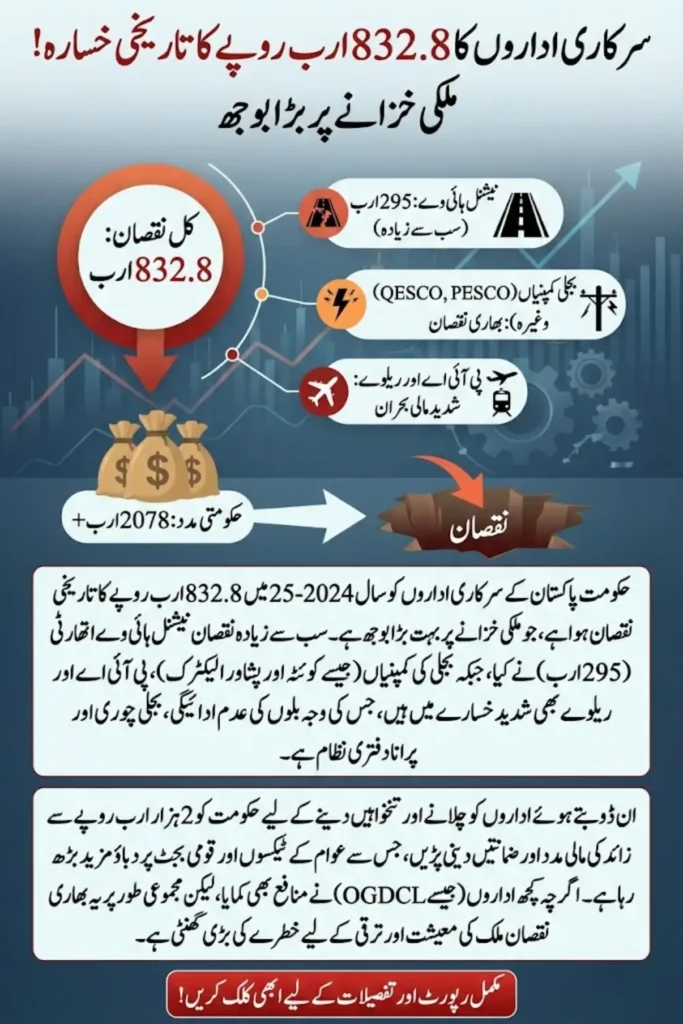
Pakistan State-Owned Enterprises Losses 2024-25 stood at Rs. 832.8 billion, according to the Ministry of Finance report for the fiscal year. Although this figure reflects a 2 percent improvement compared to the previous year, the overall financial burden remains significant. These losses highlight the ongoing structural and operational challenges faced by government-owned entities across multiple sectors.
State-owned enterprises play a critical role in infrastructure, energy, transport, and finance. However, consistent financial underperformance increases fiscal pressure on the government. Key highlights of the report include:
- Combined losses of Rs. 832.8 billion
- 2 percent annual reduction in total losses
- Continued fiscal exposure through government support
- Mixed performance across sectors
You Can Also Read: 8123 Ehsaas Rashan Program 2026 – Complete Registration, Eligibility & CNIC Check Guide
National Highway Authority Leads Pakistan State-Owned Enterprises Losses 2024-25
The National Highway Authority emerged as the largest loss-making entity during fiscal year 2024-25. The organization recorded losses of Rs. 295 billion, making it the biggest contributor to Pakistan State-Owned Enterprises Losses 2024-25. High debt servicing costs and infrastructure financing challenges were major factors behind this financial shortfall.
Infrastructure development requires heavy capital investment, and revenue generation often lags behind expenditures. This imbalance creates long-term sustainability concerns. Major contributing factors include:
- Heavy borrowing for highway projects
- High interest payments
- Maintenance and operational costs
- Delayed revenue recovery mechanisms
You Can Also Read: 8123 Ehsaas Rashan Program 2026 – Complete Registration, Eligibility
Power Distribution Companies and Sectoral Impact
The power distribution sector continued to struggle, significantly adding to Pakistan State-Owned Enterprises Losses 2024-25. Several distribution companies reported heavy financial losses due to weak bill recovery, transmission losses, and operational inefficiencies. These challenges have contributed to the broader circular debt issue in the energy sector.
Quetta Electric Supply Company and Peshawar Electric Supply Company were among the worst performers. Other distribution companies also faced losses, though at relatively smaller levels.
Power Distribution Company Losses 2024-25
| Company | Losses (Rs. Billion) |
|---|---|
| Quetta Electric Supply Company | 112.7 |
| Peshawar Electric Supply Company | 92.7 |
| Sukkur Electric Power Company | 25.3 |
| Lahore Electric Supply Company | 12.7 |
| Hyderabad Electric Supply Company | 13 |
| Islamabad Electric Supply Company | 1.4 |
Common issues in the sector include:
- Low bill recovery rates
- Electricity theft and line losses
- Rising operational expenses
- Delayed tariff adjustments
You Can Also Read: 8123 Ehsaas Rashan Program 2026
Transport Sector Contribution to Pakistan State-Owned Enterprises Losses 2024-25
The transport sector also remained under financial pressure during the fiscal year. Pakistan International Airlines reported losses of Rs. 48.9 billion, while Pakistan Railways posted losses of Rs. 60.3 billion. These figures added further strain to the overall financial position of state-owned enterprises.
High fuel costs, operational inefficiencies, and aging infrastructure contributed to these losses. Despite efforts to improve services, revenue generation has not matched rising expenditures. Key concerns include:
- Increasing fuel and maintenance costs
- Workforce management challenges
- Competition from private transport services
- Outdated operational systems
You Can Also Read: EOBI Pension 2026 – Complete Guide to Online Registration, CNIC Verification and Pension Tracking
Industrial and Postal Sector Performance
Pakistan Steel Mills recorded losses of Rs. 26 billion, reflecting ongoing operational and structural issues. The company has struggled with production halts, high liabilities, and limited modernization efforts. Similarly, Pakistan Post reported losses of Rs. 19.3 billion due to declining traditional mail services and rising administrative expenses.
These entities face intense competition from private sector alternatives and technological shifts. Major challenges include:
- Outdated production facilities
- Reduced demand in traditional services
- High administrative overheads
- Limited revenue diversification
You Can Also Read: EOBI Pension 2026 – Complete Guide to Online Registration, CNIC Verification
Profit-Making Entities Within the SOE Sector
Despite heavy losses across several sectors, some state-owned enterprises remained profitable. Combined profits reached Rs. 709 billion, although this marked a 13 percent year-on-year decline. This mixed performance indicates uneven financial strength within the SOE sector.
Oil and Gas Development Company Limited emerged as the most profitable entity with earnings of Rs. 170 billion. It was followed by Pakistan Petroleum Limited at Rs. 90 billion and National Bank of Pakistan at Rs. 57 billion.
Top Profitable State-Owned Enterprises 2024-25
| Entity | Profit (Rs. Billion) |
|---|---|
| Oil and Gas Development Company Limited | 170 |
| Pakistan Petroleum Limited | 90 |
| National Bank of Pakistan | 57 |
These profits help offset some losses but do not eliminate the overall fiscal burden.
You Can Also Read: EOBI Pension 2026 – Complete Guide to Online Registration
Government Financial Support and Fiscal Exposure
To sustain operations of state-owned enterprises, the government extended financial backing amounting to Rs. 2,078 billion during fiscal year 2024-25. In addition, sovereign guarantees worth Rs. 2,164 billion were issued. This support highlights the scale of fiscal exposure linked to the SOE sector.
Such financial backing ensures continuity of essential public services but increases pressure on national finances. Key aspects of government support include:
- Direct financial injections
- Sovereign guarantees for borrowing
- Debt servicing assistance
- Budgetary allocations for operational stability
You Can Also Read: 9999 Web Portal Registration 2026 – Complete Guide to PM Ramzan Relief Package CNIC Check & Online Apply
Overall Financial Trend and Outlook
Although Pakistan State-Owned Enterprises Losses 2024-25 declined by 2 percent, the overall financial position remains fragile. Loss-making entities continue to outweigh profit-generating organizations in terms of fiscal impact. The decline in profitability among top-performing SOEs further complicates the situation.
Sustainable reform, improved governance, and operational efficiency are essential to reduce future losses. Focus areas for improvement include:
- Corporate governance reforms
- Improved financial transparency
- Cost-control measures
- Revenue enhancement strategies
You Can Also Read: 9999 Web Portal Registration 2026 – Complete Guide to PM Ramzan Relief Package CNIC Check
FAQs
What were the total Pakistan State-Owned Enterprises Losses 2024-25?
The combined losses reached Rs. 832.8 billion during fiscal year 2024-25, according to the Ministry of Finance.
Which entity recorded the highest loss?
The National Highway Authority reported the largest loss, totaling Rs. 295 billion.
Did any state-owned enterprises make a profit?
Yes, several entities generated profits, with Oil and Gas Development Company Limited earning Rs. 170 billion.
How much financial support did the government provide?
The government extended Rs. 2,078 billion in support and issued Rs. 2,164 billion in sovereign guarantees.
Did losses improve compared to the previous year?
Yes, total losses declined by 2 percent compared to the previous fiscal year, indicating slight improvement.
You Can Also Read: 9999 Web Portal Registration 2026