
FBR Cyber Attack 2026: Rs. 74.8 Million Tax Fraud Exposed in Pakistan’s IRIS System
FBR Cyber Attack 2026
The FBR Cyber Attack 2026 has raised serious concerns about the safety of Pakistan’s digital tax infrastructure. The incident was uncovered by the Federal Tax Ombudsman, revealing that unauthorized individuals gained access to sensitive tax records and manipulated financial data. This breach highlights the growing risks associated with weak cybersecurity systems.
Such incidents not only affect individual taxpayers but also damage trust in digital governance. The exposure of this fraud shows the urgent need for stronger protection mechanisms in national systems.
- Unauthorized access to tax records
- Large-scale financial manipulation
- Increased cybersecurity concerns
You Can Also Read: Mera Ghar Mera Ashiana Scheme 2026: Eligibility, Apply Through Banks, Installment Plan & Benefits
What is FBR Cyber Attack 2026?
The FBR Cyber Attack 2026 refers to a cyber intrusion into the tax system managed by the Federal Board of Revenue. Hackers illegally accessed a taxpayer’s IRIS profile and altered official records without authorization.
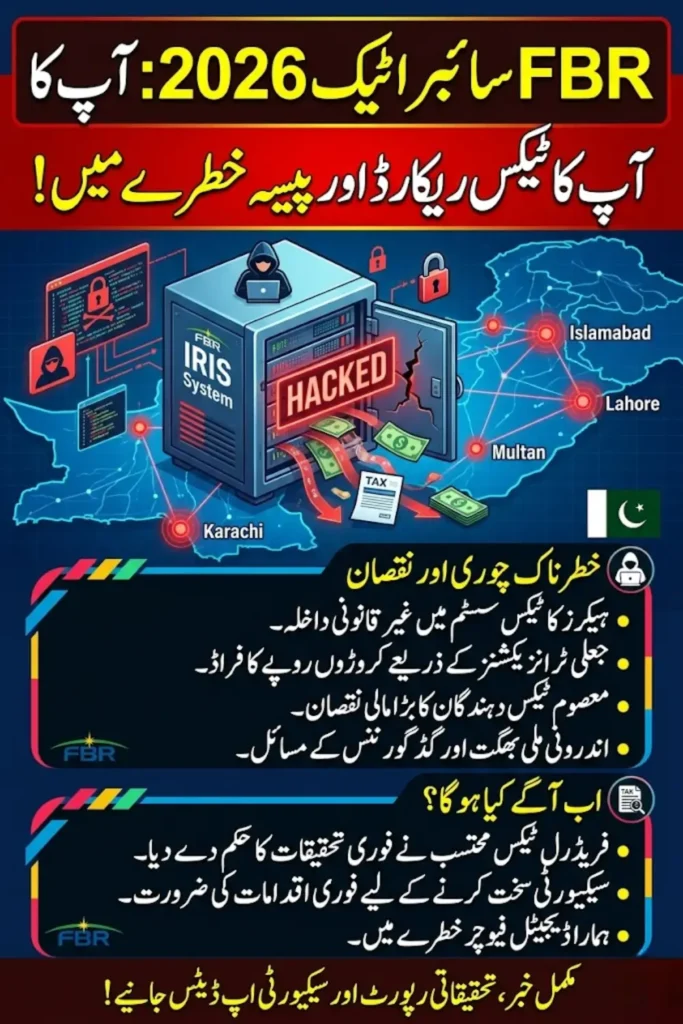
This manipulation involved revising a sales tax return and inserting fake transaction data. Such activities expose vulnerabilities in system controls and user authentication processes.
- Unauthorized login access
- Manipulation of tax returns
- Weak system security controls
Details of Rs. 74.8 Million Tax Fraud Case
The investigation revealed that fraudulent adjustments were made to input tax credit totaling Rs. 74.8 million. This resulted in significant financial loss for the affected taxpayer.
The fraud was executed by introducing fake supply entries, which distorted the actual tax record. This shows how digital systems can be misused if not properly secured.
- Rs. 74.8 million tax credit affected
- Fake entries added to records
- Financial loss for taxpayer
You Can Also Read: FBR Digital Tax System Issues 2026: PTBA Demands Urgent Reforms and System Fixes
How Hackers Accessed the IRIS System
Hackers gained access by misusing login credentials, which allowed them to enter the taxpayer’s profile without detection. This indicates gaps in authentication and monitoring systems.
Such access can occur when credentials are not properly protected or when systems lack additional verification layers. Strengthening login security is essential to prevent such breaches.
- Misuse of login credentials
- Lack of strong authentication
- Weak monitoring systems
Fake Transactions and Sales Tax Manipulation
The attackers introduced fake supplies worth Rs. 415.6 million into the system. This manipulation removed the taxpayer’s carry-forward input tax credit entirely.
Such fraudulent activity not only affects individuals but also disrupts the overall tax system. It creates false data that can impact financial reporting and compliance.
- Fake supplies worth Rs. 415.6 million
- Removal of valid tax credit
- Distortion of financial records
You Can Also Read: FPSC General Recruitment Test 2026 New Dates Announced: Revised Schedule, Admit Cards & Updates
Role of Organized Network in FBR Cyber Attack 2026
Investigations suggest that this was not an isolated incident but part of a larger organized network. Multiple individuals may have been involved in executing the fraud.
Organized cybercrime groups often target systems with weak controls. This case indicates coordinated efforts to exploit vulnerabilities for financial gain.
- Evidence of coordinated fraud
- Multiple individuals involved
- Structured cybercrime activity
Involvement of FBR and PRAL Linked Individuals
There are indications that individuals linked to Pakistan Revenue Automation Limited and FBR may have facilitated the fraud. This raises serious governance concerns.
If insiders are involved, it highlights the need for strict accountability and monitoring within institutions. Internal controls must be strengthened to prevent misuse.
- Possible insider involvement
- Governance concerns
- Need for accountability
You Can Also Read: Nusuk Card Hajj 2026 – Mandatory Requirement for Pilgrims in Saudi Arabia
Use of Dormant and Blacklisted Taxpayer Data
Cybercriminals exploited data from dormant and blacklisted taxpayers to carry out the fraud. These accounts were used to insert fake transactions into the system.
Such accounts are often less monitored, making them easier targets. This shows the importance of regularly reviewing and securing inactive profiles.
- Targeting inactive accounts
- Use of blacklisted data
- Weak monitoring of dormant profiles
Cities Affected by the Cyber Fraud Network
The fraudulent activity was traced across multiple cities, including Karachi, Lahore, Multan, Quetta, and Islamabad. This indicates a nationwide network.
The wide geographic spread shows that the issue is not limited to one region. It requires coordinated efforts from authorities across the country.
- Karachi
- Lahore
- Multan, Quetta, Islamabad
You Can Also Read: Maryam Nawaz Electric Bike Scheme 2026: Eligibility, Apply Online, Installment Plan & Latest Updates
Federal Tax Ombudsman’s Findings and Orders
The Federal Tax Ombudsman termed the incident as maladministration and ordered a detailed investigation. This step is crucial for identifying those responsible.
The ombudsman also directed authorities to restore the affected taxpayer’s rights and ensure corrective actions are taken.
- Declared as maladministration
- Ordered detailed investigation
- Focus on corrective measures
Investigation by Directorate General of Intelligence
The Directorate General of Intelligence and Investigation (Inland Revenue) has been tasked with conducting a thorough probe. This includes analyzing digital evidence and tracking IP addresses.
Such investigations are essential to identify all individuals involved, whether inside or outside official institutions.
- Use of digital evidence
- IP tracking for identification
- Comprehensive investigation process
You Can Also Read: How to Check PTA Approved Mobile in Pakistan 2026 Using IMEI (SMS, DIRBS & App Methods)
Legal Action Against Beneficiaries and Hackers
Authorities have identified several beneficiaries of the fraud and plan to take legal action against them. This is a critical step toward accountability.
Legal proceedings will help deter similar crimes in the future and strengthen confidence in the system.
- Identification of suspects
- Legal proceedings initiated
- Focus on accountability
System Weaknesses in Pakistan’s Tax Infrastructure
The incident highlights major weaknesses in Pakistan’s digital tax system. These include poor security controls and lack of proper verification mechanisms.
Addressing these weaknesses is essential to prevent future cyber attacks and protect sensitive financial data.
- Weak cybersecurity measures
- Lack of monitoring systems
- Insufficient verification controls
You Can Also Read: Mera Ghar Mera Ashiana Scheme 2026: Eligibility, Apply Through Banks, Installment Plan & Benefits
Recommended Security Upgrades for IRIS System
To prevent similar incidents, experts have recommended several upgrades. These include biometric verification and stronger login controls.
Improving system security will reduce the risk of unauthorized access and enhance overall reliability.
- Biometric verification
- Stronger credential controls
- Improved supervision
FBR Compliance Report and Future Actions
The Federal Board of Revenue has been directed to submit a compliance report within 60 days. This report will outline actions taken to address the issue.
Future measures will focus on strengthening system security and preventing similar incidents.
- 60-day compliance deadline
- Reporting on progress
- Preventive measures implementation
You Can Also Read: FBR Digital Tax System Issues 2026: PTBA Demands Urgent Reforms and System Fixes
Summary of Key Issues and Solutions
| Issue | Solution |
|---|---|
| Unauthorized access | Strong authentication system |
| Fake transactions | Real-time monitoring |
| Insider involvement | Strict accountability measures |
| Weak cybersecurity | System upgrades and audits |
| Lack of verification | Biometric authentication |
FAQs
What is FBR Cyber Attack 2026?
It refers to a cyber intrusion where hackers manipulated tax records in Pakistan’s IRIS system.
How much financial loss was reported?
The fraud involved adjustments of Rs. 74.8 million in input tax credit.
How did hackers access the system?
They used stolen or misused login credentials to gain unauthorized access.
What actions are being taken now?
Authorities are investigating the case and implementing stronger security measures.
Conclusion
The FBR Cyber Attack 2026 has exposed serious vulnerabilities in Pakistan’s digital tax infrastructure. The involvement of organized networks and possible insiders makes the situation even more concerning.
To restore trust and prevent future incidents, strong cybersecurity measures, strict accountability, and system upgrades are essential. Strengthening digital systems will ensure a safer and more reliable tax environment for all users.
You Can Also Read: FPSC General Recruitment Test 2026 New Dates Announced: Revised Schedule