
Pakistan Net Metering Policy 2026
Pakistan has officially ended its net metering policy regime with the notification of the Prosumer Regulations 2026 by the NEPRA. This marks a major shift in how rooftop solar electricity is settled, replacing the long-standing unit-for-unit adjustment mechanism with a net billing framework. Under the new policy, consumers who generate electricity through solar systems will no longer offset exported units directly against imported units.
The decision aims to align consumer-level power generation with the national tariff structure and reduce financial distortions in the power sector. NEPRA stated that the revised framework will bring greater transparency, standardization, and long-term grid sustainability.
- Net metering system officially discontinued
- Prosumer Regulations 2026 enforced nationwide
- Unit-for-unit adjustment replaced by net billing
- Focus on tariff alignment and transparency
You Can Also Read: Biometric Attendance and Digital Marking
What Changed Under Pakistan Net Metering Policy 2026?
Previously, net metering consumers could export surplus electricity to the grid and receive one-to-one unit credits against their consumption. This allowed solar users to significantly reduce their electricity bills, often avoiding major portions of grid charges.
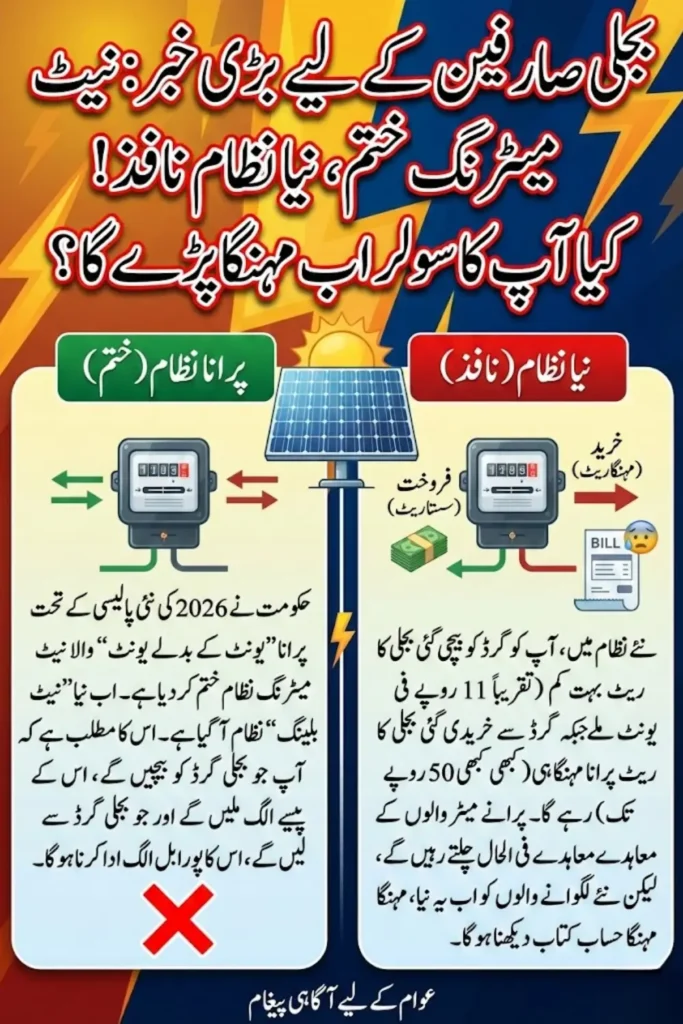
Under the new net billing system, electricity supplied to and taken from the grid will be treated as separate transactions. Consumers will pay retail tariffs for grid electricity while receiving a lower rate for surplus power exported to the grid.
- End of one-to-one electricity adjustment
- Separate billing for import and export
- Monthly settlement cycle introduced
- New commercial structure for rooftop solar
You Can Also Read: Ramzan Relief Package 2026 – Complete Guide
Revised Solar Buyback Rate for Exported Electricity
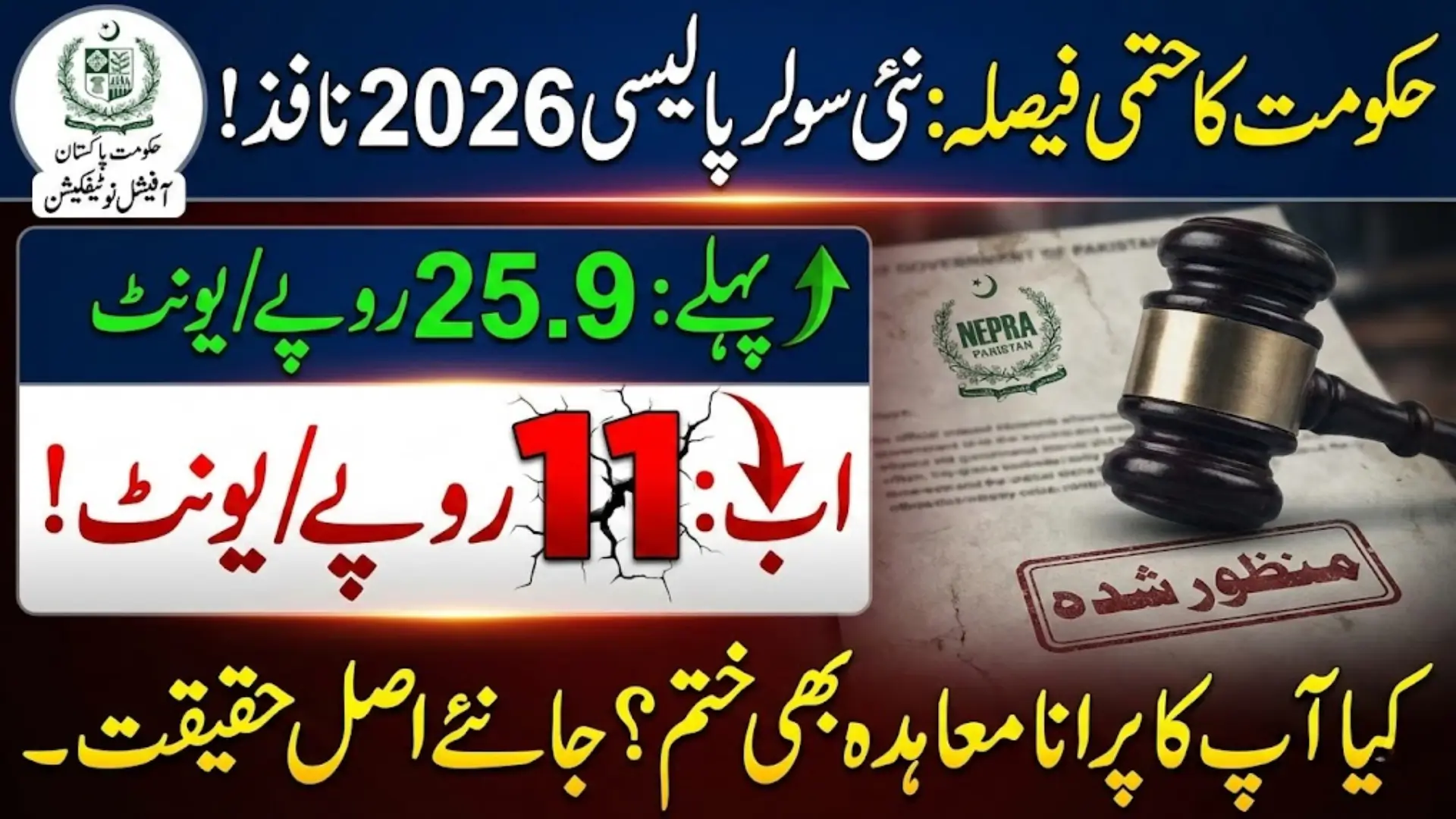
The most significant change under the Pakistan Net Metering Policy 2026 is the reduction in the buyback rate for surplus electricity. Previously, solar consumers were paid around Rs. 25.9 per unit for electricity exported to the grid.
Under the new framework, the purchase rate is expected to fall to nearly Rs. 11 per unit, based on the National Average Energy Price. This change substantially alters the financial returns of rooftop solar systems.
- Previous export rate: Rs. 25.9 per unit
- New proposed rate: Around Rs. 11 per unit
- Based on national average energy pricing
- Applies to new net billing consumers
You Can Also Read: PM Ramzan Cash and Rashan Support
Electricity Tariffs Charged to Solar Consumers
While the buyback rate for solar exports has been reduced, distribution companies will continue charging solar consumers the applicable retail tariff for electricity drawn from the grid. These tariffs can reach as high as Rs. 50 per unit depending on the consumer category.
This widening gap between buying and selling prices significantly changes the economics of rooftop solar. Consumers will now need to carefully assess consumption patterns and system sizing.
- Grid electricity charged at retail tariff
- Rates may go up to Rs. 50 per unit
- No offsetting through unit credits
- Higher cost difference for prosumers
You Can Also Read: 8123 Ehsaas Rashan Programme 2026
Applicability of Prosumer Regulations 2026
The new policy does not immediately affect existing net metering consumers. Those with valid contracts will continue under previous terms until their agreements expire. After expiry, distribution companies are authorized to either terminate the contract or shift consumers to the new net billing system.
NEPRA has also limited the contract duration to five years, with an option for renewal for an additional five-year term.
- Existing contracts protected temporarily
- Transition after contract expiry allowed
- Five-year contract limit introduced
- Renewal subject to regulatory approval
You Can Also Read: 9999 CNIC Check for Ramzan Relief Package 2026 – Complete Guide to PM Ramzan Cash and Rashan Support
Net Billing Mechanism Explained
Under the net billing framework, billing will be conducted at the end of each 30-day billing cycle. Electricity consumed from the grid and electricity exported to the grid will be calculated separately based on actual metered data.
Payments for surplus electricity will be made independently, moving away from the earlier adjustment-based model. This ensures clearer accounting and tariff compliance.
- Monthly billing cycle
- Separate import and export settlement
- Payments made independently
- Meter-based energy calculation
You Can Also Read: 9999 CNIC Check for Ramzan Relief Package 2026
Inclusion of Wind and Biogas Prosumers
The Prosumer Regulations 2026 expand the regulatory scope beyond solar energy. Distributed generation using wind and biogas technologies up to a capacity of one megawatt is now included under the same net billing framework.
This unified structure ensures consistent treatment of all small-scale power producers and removes earlier regulatory gaps.
- Solar, wind, and biogas included
- Capacity limit set at 1 MW
- Uniform settlement mechanism
- Standardized regulatory oversight
You Can Also Read: Matric and Intermediate Exams Reforms 2026 Introduce Biometric Attendance and Digital Marking
Eligible Consumers Under the New Framework
NEPRA has defined eligible consumers broadly to include residential, commercial, industrial, agricultural, and general services users. Eligible connections must be at 400V or 11kV and require approval from the relevant distribution company.
Interconnection with the distribution system is mandatory, ensuring grid safety and technical compliance.
- Residential and commercial users included
- Industrial and agricultural consumers eligible
- 400V and 11kV connection levels
- Disco approval required
You Can Also Read: Matric and Intermediate Exams Reforms 2026
Suspension of Net Metering Regulations 2015
With the enforcement of the Prosumer Regulations 2026, the Net Metering Regulations 2015 have been automatically suspended. NEPRA stated that the older framework no longer aligned with current market realities and grid requirements.
The new regulations aim to modernize distributed generation and integrate it into the broader power sector planning framework.
- 2015 regulations suspended
- Updated regulatory structure introduced
- Focus on system-wide alignment
- Modernized power sector approach
You Can Also Read: MBBS BDS Admission Criteria 2025–26 Under Review After SMBBMU Request to PMDC
NEPRA’s Expanded Regulatory Powers
Under the new regulations, NEPRA has granted itself enhanced oversight powers. The authority can revise purchase rates during the contract period, issue binding operational directions, and demand performance data from prosumers.
It can also impose penalties and relax or modify provisions when necessary to protect grid stability and financial balance.
- Authority to revise buyback rates
- Power to issue binding directions
- Access to operational data
- Penalty enforcement provisions
You Can Also Read: MBBS BDS Admission Criteria 2025–26
Financial Impact of Net Metering on Power Sector
NEPRA cited significant financial losses caused by rapid rooftop solar adoption. In FY2024 alone, electricity sales dropped by 3.2 billion units, resulting in nearly Rs. 101 billion in losses for distribution companies.
These losses were passed on to remaining consumers through higher tariffs, increasing electricity prices by around Rs. 0.9 per unit.
- FY2024 sales drop: 3.2 billion units
- Financial loss: Rs. 101 billion
- Tariff burden shifted to consumers
- Revenue erosion for Discos
You Can Also Read: PSER Punjab Gov PK Registration 2026: 8070 Online Registration, Eligibility Check & Ramzan Relief Guide
Why Net Metering Was Considered Regressive?
Regulators argued that net metering disproportionately benefited wealthier households with rooftop solar systems. Fixed costs such as grid maintenance and capacity payments were shifted onto non-solar consumers.
Without reform, projections showed that lost grid sales could reach 18.8 billion units by FY2034, with a cumulative financial impact of Rs. 545 billion.
- Cost burden shifted to non-solar users
- Wealth-based inequality concerns
- Projected tariff rise of Rs. 5–6 per unit
- Long-term sustainability risks
Comparison of Old and New Solar Settlement Systems
| System Feature | Net Metering (Old) | Net Billing (New) |
|---|---|---|
| Electricity Adjustment | Unit-for-unit | Separate billing |
| Export Rate | Rs. 22–27 per unit | Around Rs. 11 per unit |
| Import Charges | Offset by exports | Full retail tariff |
| Billing Method | Monthly adjustment | Monthly settlement |
This comparison highlights how the new system significantly changes rooftop solar economics.
Grid Stability and Operational Concerns
Operational risks have also increased due to rapid solar adoption. During winter months, national electricity demand drops to 8,000–9,000 megawatts, while solar output peaks during daytime hours.
This imbalance raised concerns about over-generation and frequency instability, prompting regulators to act.
- Low winter demand levels
- High daytime solar output
- Risk of grid frequency issues
- Over-generation challenges
You Can Also Read: PSER Punjab Gov PK Registration 2026
New Technical Restrictions on Distributed Generation
To manage grid risks, NEPRA has capped distributed generation capacity at one megawatt per consumer. Capacity is also restricted to the sanctioned load, and new connections are barred where transformer utilization exceeds 80 percent.
These measures aim to protect infrastructure and maintain system reliability.
- Capacity cap of 1 MW
- Limited to sanctioned load
- Transformer utilization threshold applied
- Grid protection measures enforced
Rooftop Solar Capacity in Pakistan
Pakistan’s rooftop solar capacity is now estimated at around 6,000 megawatts. Most installations are concentrated in urban residential, commercial, and industrial sectors.
While solar has reduced daytime grid demand, it has also created revenue and operational challenges for utilities.
- Estimated capacity: 6,000 MW
- Urban concentration of systems
- Reduced daytime demand
- Utility revenue impact
You Can Also Read: Imam Masjid Wazifa Program 2026 Launched in Punjab: Official Selected List, Eligibility & How to Check Status
Conclusion
The Pakistan Net Metering Policy 2026 represents a fundamental shift in the country’s rooftop solar landscape. By ending unit-for-unit net metering and introducing net billing, NEPRA aims to reduce financial losses, correct tariff distortions, and improve grid stability.
While the reforms may slow rooftop solar expansion, regulators argue they are necessary to ensure fairness, sustainability, and long-term reliability of the power system.
You Can Also Read: Imam Masjid Wazifa Program 2026 Launched in Punjab: Official Selected List
Frequently Asked Questions
What is Pakistan Net Metering Policy 2026?
It is a new regulatory framework that replaces net metering with net billing for rooftop solar users.
Will existing net metering consumers be affected immediately?
No, existing consumers will remain under old terms until their contracts expire.
What is the new buyback rate for solar electricity?
The rate is expected to be around Rs. 11 per unit under net billing.
How will solar consumers be billed now?
They will pay retail tariffs for grid electricity and receive separate payments for exported energy.
Why did NEPRA end net metering?
To reduce financial losses, tariff distortions, and grid instability caused by rapid solar adoption.
You Can Also Read: Imam Masjid Wazifa Program 2026 Launched in Punjab