
Introduction to Russia Blocks WhatsApp Decision
Russia blocks WhatsApp in a major move that has changed the country’s digital communication landscape. The decision was confirmed by Kremlin spokesperson Dmitry Peskov, who stated that the messaging platform failed to comply with national regulations. With more than 100 million users in Russia, WhatsApp was one of the most widely used apps for personal and business communication.
The action has created uncertainty among users who relied on the platform for daily interaction. Authorities argue that foreign messaging services must follow Russian laws to continue operating in the country.
- Government claims WhatsApp did not meet legal data requirements
- Over 100 million users affected nationwide
- Restrictions introduced gradually before full blocking
- Officials say move protects national digital sovereignty
You Can Also Read: 8123 Ehsaas Rashan Program 2026 – Complete Registration, Eligibility & CNIC Check Guide
Why Russia Blocks WhatsApp Amid Legal Disputes
The core reason Russia blocks WhatsApp is linked to data storage and security compliance. Russian law requires foreign technology companies to store user data on local servers within the country. Authorities claim WhatsApp failed to fully meet these obligations, which led to escalating regulatory pressure.
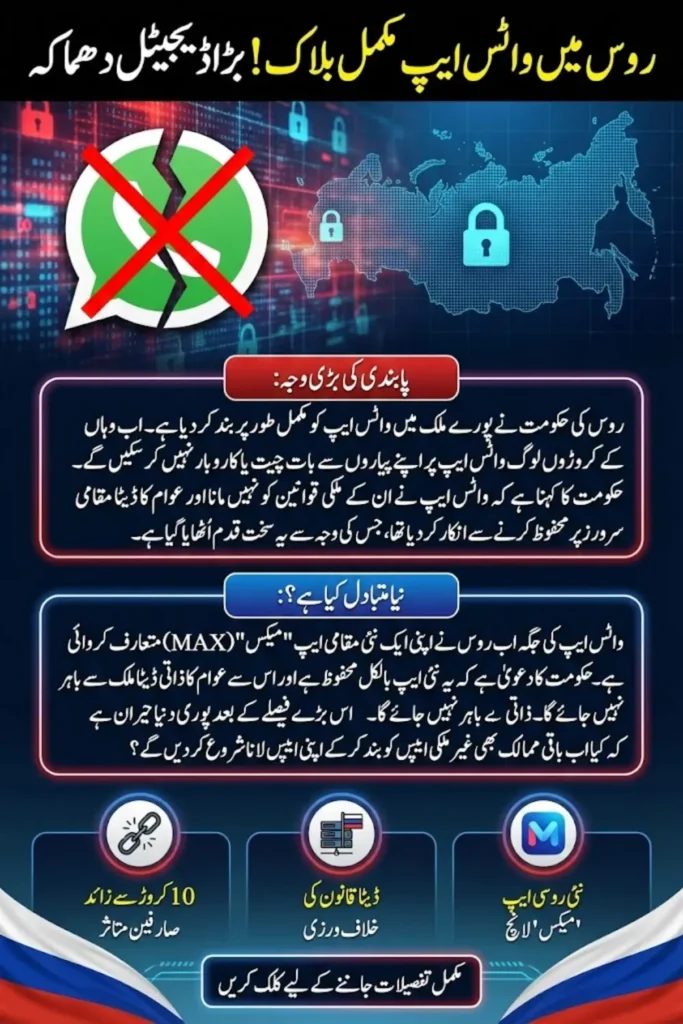
In addition, officials have accused the platform of not doing enough to prevent online fraud and extremist activities. The parent company, Meta Platforms, has already faced restrictions in Russia in recent years.
- Data localization laws require local storage of user data
- Authorities cite national security concerns
- Meta previously restricted in Russia
- Officials argue foreign apps must follow domestic rules
You Can Also Read: 8123 Ehsaas Rashan Program 2026
Promotion of MAX as a National Alternative
Following the ban, Russian authorities have promoted MAX as a domestic messaging alternative. The app is positioned as a secure and government-compliant platform designed to serve both communication and digital service needs. Officials describe MAX as a tool that strengthens Russia’s independent digital ecosystem.
Critics, however, question whether MAX ensures the same level of privacy as global platforms. The government has denied allegations of surveillance, stating that the app meets all legal standards while protecting citizens’ data.
- MAX integrated with government digital services
- Promoted as a secure national platform
- Critics raise privacy concerns
- Officials deny claims of surveillance misuse
You Can Also Read: Ehsaas 8123 Rashan Program 2026 – Online Registration, Eligibility Criteria, and Complete Application Guide
The Role of Roskomnadzor in Enforcing Restrictions
The enforcement of the ban was carried out by Roskomnadzor, Russia’s federal communications regulator. The agency has been responsible for monitoring and restricting digital platforms that do not comply with national regulations. In recent years, it has tightened oversight over foreign technology companies.
Restrictions on WhatsApp were introduced step by step, including limiting certain features before the complete block. Users reported disruptions in calls and message delivery prior to the final action.
- Gradual service limitations before full ban
- Removal from national domain systems
- Increased oversight of foreign tech firms
- Focus on digital sovereignty enforcement
You Can Also Read: Ehsaas 8123 Rashan Program 2026 – Online Registration
Impact on Telegram and Other Platforms
The decision to block WhatsApp has also affected other messaging platforms, including Telegram. Users have reported occasional slowdowns and access challenges. Authorities have indicated that all digital platforms must comply with Russian regulations or face similar consequences.
The broader policy suggests a shift toward stronger control of foreign technology services operating within Russia. Companies are now under pressure to align with domestic legal frameworks to maintain access to the market.
- Increased scrutiny of Telegram
- Possible future compliance checks
- Pressure on foreign digital services
- Emphasis on domestic control of online platforms
You Can Also Read: EOBI Pension Online Check by CNIC 2026 – Complete Guide to Pension Verification, Registration, and Payments
Public Reaction Inside Russia
Public reaction to the decision has been mixed. Some citizens view the move as necessary for national security and digital independence. Others are concerned about losing access to international communication tools and the impact on personal freedoms.
Many users have explored alternative methods such as virtual private networks to maintain access to blocked services. At the same time, a segment of the population appears willing to transition to locally supported platforms.
- Mixed response from citizens
- Concerns about freedom of communication
- VPN usage increasing
- Some users shifting to MAX
You Can Also Read: EOBI Pension Online Check by CNIC 2026 – Complete Guide to Pension Verification
Comparison of WhatsApp and MAX
| Feature | MAX | |
|---|---|---|
| Ownership | Meta Platforms | Russian developers |
| Data Storage | Global servers | Local Russian servers |
| Government Integration | Limited | Integrated services |
| Regulatory Compliance | Disputed in Russia | Fully aligned with Russian law |
Broader Context of Digital Infrastructure Control
Russia’s decision to block WhatsApp is part of a wider effort to control its digital infrastructure. In previous years, platforms like Instagram and Facebook were also restricted. These actions reflect a long-term strategy to reduce reliance on foreign technology services.
The government argues that building a sovereign digital ecosystem protects national interests. Critics, however, warn that such policies may isolate users from global communication networks and limit access to independent information.
- Previous bans on major social media platforms
- Push for national digital independence
- Reduced reliance on foreign companies
- Debate over digital freedom and privacy
You Can Also Read: EOBI Pension Online Check by CNIC 2026
Key Timeline of Events
| Year | Event |
|---|---|
| 2022 | Increased regulation of foreign tech platforms |
| 2023 | Expanded oversight by Roskomnadzor |
| 2025 | Partial service disruptions reported |
| 2026 | Full blocking of WhatsApp announced |
Conclusion
Russia blocks WhatsApp as part of a broader digital policy aimed at strengthening national control over communication platforms. Authorities emphasize legal compliance and data sovereignty as key reasons behind the decision.
The long-term impact remains uncertain. While the government promotes domestic alternatives like MAX, users continue to evaluate privacy, accessibility, and global connectivity concerns. The situation highlights the growing divide between international tech companies and national regulatory frameworks.
You Can Also Read: Maryam Ko Batayn App – Complete Guide to Maryam Ko Batayn 10000 Ration Program 2026
FAQs
Why did Russia block WhatsApp?
Russia blocked WhatsApp due to alleged non-compliance with data localization and security regulations. Authorities say the platform failed to meet national legal standards.
What is MAX app in Russia?
MAX is a domestic messaging platform promoted by the Russian government. It is designed to comply fully with local laws and integrate government services.
Is Telegram banned in Russia?
Telegram is not fully banned, but it faces regulatory scrutiny. Authorities have warned that all platforms must follow Russian regulations.
Can users still access WhatsApp in Russia?
Some users attempt access through VPN services. However, the platform remains officially blocked within the country.
You Can Also Read: PTA 5G Spectrum Auction 2026 – Mandatory 2600 MHz and 3500 MHz Bands for Telecom Operators