
Pakistan Receives $1.3 Billion IMF Loan After Successful EFF and RSF Reviews
Pakistan Receives $1.3 Billion IMF Loan
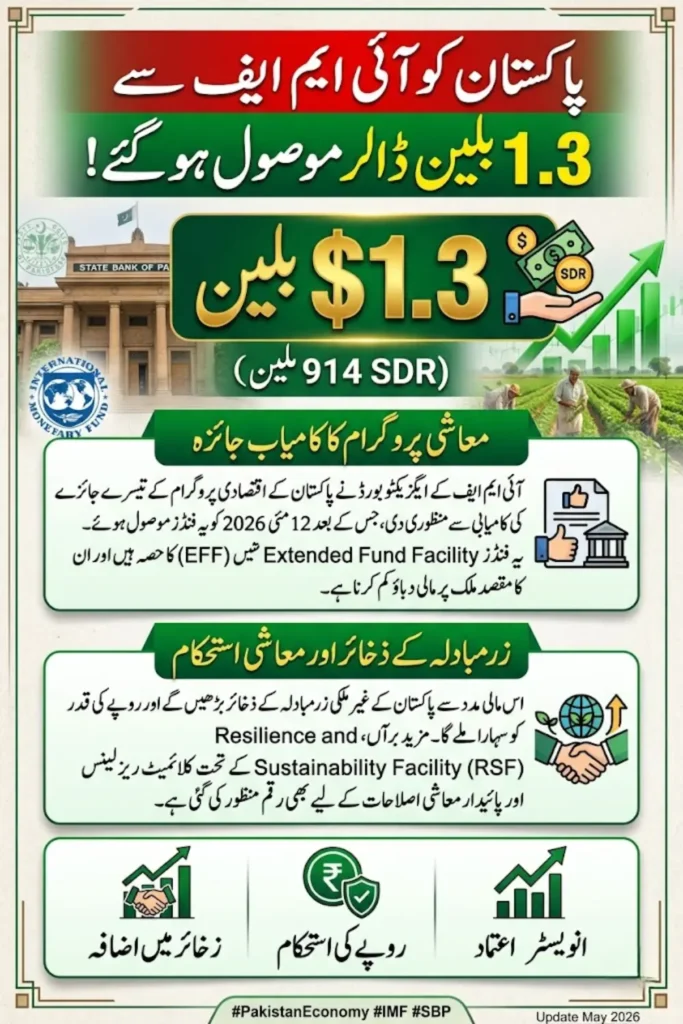
Pakistan has received approximately $1.3 billion from the International Monetary Fund (IMF) after the successful completion of important economic program reviews. The State Bank of Pakistan (SBP) confirmed the development and stated that the funds were transferred on May 12, 2026. This financial support is being seen as an important step toward improving the country’s foreign exchange reserves and strengthening economic stability.
The approval came after the IMF Executive Board completed the third review under Pakistan’s Extended Fund Facility (EFF). Along with this, the second tranche under the Resilience and Sustainability Facility (RSF) was also approved. The latest IMF disbursement is expected to support Pakistan’s economy during a challenging financial period.
You Can Also Read: Punjab School Summer Vacations 2026 Announced guide for parents and students
IMF Approves Third Review Under Extended Fund Facility
The IMF Executive Board held its meeting on May 8, 2026, where it reviewed Pakistan’s progress under the Extended Fund Facility program. After assessing economic reforms and policy measures, the board approved the release of Special Drawing Rights (SDR) worth 760 million. This amount forms a major portion of the total financial support received by Pakistan.
The Extended Fund Facility is designed to help countries facing balance of payment difficulties and economic instability. Pakistan has been working with the IMF to implement reforms aimed at reducing fiscal pressure, improving revenue collection, and stabilizing the economy. The successful completion of the third review indicates that the country met several important conditions agreed upon with the IMF.
Key points from the EFF review include:
- IMF approved SDR 760 million for Pakistan
- Review was completed during the May 8, 2026 meeting
- Funds are part of the Extended Fund Facility program
- The program focuses on economic reforms and stability
You Can Also Read: Electricity Bill Taxes in Pakistan Reach Rs. 700 Billion in FY 2024-25
Pakistan Receives Additional Climate Support Under RSF
In addition to the EFF approval, Pakistan also secured support under the Resilience and Sustainability Facility. The IMF approved the second tranche of SDR 154 million through this program. The RSF is designed to help countries improve economic resilience and address climate-related challenges.
Pakistan remains highly vulnerable to climate change, including floods, heatwaves, and agricultural losses. Financial support under the RSF can help the country strengthen infrastructure, improve disaster preparedness, and develop sustainable economic policies. The approval reflects international confidence in Pakistan’s efforts to improve resilience against environmental risks.
The RSF program mainly supports:
- Climate resilience projects
- Sustainable economic reforms
- Long-term environmental planning
- Financial stability during climate challenges
Total IMF Disbursement Reaches $1.3 Billion
According to the State Bank of Pakistan, the country received a total of SDR 914 million from the IMF on May 12, 2026. This amount is equal to approximately $1.3 billion. The latest inflow is expected to provide relief to Pakistan’s external financing position and support the country’s reserve levels.
The increase in foreign exchange reserves can help Pakistan manage import payments and reduce pressure on the local currency. Economists believe that IMF funding also improves investor confidence because it signals continued international support for economic reforms.
| IMF Program | Approved Amount | Purpose |
|---|---|---|
| Extended Fund Facility (EFF) | SDR 760 Million | Economic stabilization and reforms |
| Resilience and Sustainability Facility (RSF) | SDR 154 Million | Climate resilience and sustainability |
| Total Received by Pakistan | SDR 914 Million | Strengthening reserves and economy |
Impact on Pakistan’s Foreign Exchange Reserves
The State Bank of Pakistan stated that the IMF inflow will appear in the country’s official foreign exchange reserves for the week ending May 15, 2026. Foreign reserves are important because they help countries pay for imports, manage debt obligations, and maintain financial confidence in international markets.
An increase in reserves can also help stabilize the Pakistani rupee by reducing uncertainty in currency markets. Higher reserves provide support to the central bank in managing external economic pressures. Analysts believe that the latest IMF support may improve short-term financial stability and strengthen Pakistan’s position in global financial markets.
Some expected benefits of higher reserves include:
- Better import payment capacity
- Improved investor confidence
- Reduced pressure on the rupee
- Greater financial stability
You Can Also Read: Car E Smart Card Online Registration Guide and Digital Vehicle Verification Benefits
Pakistan’s Economy Shows Signs of Improvement
Recent reports from the State Bank of Pakistan have highlighted improvements in the economy during the first half of fiscal year 2026. Inflation pressures have eased compared to previous years, while some economic indicators have shown gradual recovery. IMF support is expected to further strengthen this progress.
However, the central bank also warned about possible risks linked to regional tensions and global uncertainties. Economic recovery still depends on maintaining reforms, controlling inflation, and improving exports. Pakistan will likely continue working closely with international financial institutions to achieve long-term stability.
| Economic Area | Expected Impact of IMF Funding |
|---|---|
| Foreign Exchange Reserves | Increase in reserve levels |
| Currency Stability | Reduced pressure on rupee |
| Investor Confidence | Positive market sentiment |
| Economic Reforms | Continued policy implementation |
Importance of IMF Programs for Pakistan
IMF programs play a major role in helping Pakistan manage financial challenges. The funding provides temporary economic relief while encouraging structural reforms aimed at improving governance and fiscal discipline. These reforms often focus on taxation, energy pricing, and public sector management.
The relationship between Pakistan and the IMF has remained important for decades due to recurring balance of payment pressures. While IMF programs can be challenging because of strict conditions, they also provide access to international financing and improve economic credibility in global markets.
Important objectives of IMF assistance include:
- Supporting economic reforms
- Improving fiscal management
- Stabilizing external accounts
- Strengthening long-term growth
You Can Also Read: IMF Pakistan Economic Forecast Revised as Growth Outlook Weakens for FY27
Future Outlook for Pakistan’s Economy
The latest IMF disbursement is expected to support Pakistan’s short-term economic needs and strengthen financial reserves. Continued cooperation with the IMF may help the country secure further international support and maintain macroeconomic stability in the coming months.
Experts believe that long-term success will depend on consistent reforms, stronger exports, investment growth, and political stability. Pakistan’s ability to manage inflation and maintain fiscal discipline will remain important for sustaining economic recovery and reducing future financial risks.
You Can Also Read: Oppo Find X10 Pro Max Leak Reveals Dual 200MP Cameras and 2nm Chipset
FAQs
What is the total amount received by Pakistan from the IMF?
Pakistan received approximately $1.3 billion, equal to SDR 914 million, from the IMF after successful program reviews.
What is the Extended Fund Facility (EFF)?
The EFF is an IMF program designed to help countries facing economic difficulties through financial support and reforms.
What is the purpose of the Resilience and Sustainability Facility (RSF)?
The RSF supports countries in improving climate resilience and managing environmental and economic risks.
How will the IMF funding help Pakistan?
The funds will strengthen foreign exchange reserves, improve investor confidence, and support economic stability.
When will the IMF inflow appear in Pakistan’s reserves?
According to the SBP, the inflow will be reflected in reserves for the week ending May 15, 2026.
You Can Also Read: Rs. 700 Million e-Learn She Earn Program Launched by CM Maryam Nawaz in Punjab