Pakistan to End Gas Cross-Subsidy System Under IMF Energy Reform Plan
Pakistan Gas Cross-Subsidy System
The Government of Pakistan has committed to the International Monetary Fund (IMF) to abolish the existing Pakistan Gas Cross-Subsidy System as part of wider energy sector reforms. Under the new arrangement, the current consumption-based gas subsidy system for protected and certain non-protected consumers will be replaced with targeted financial assistance linked to household income through the Benazir Income Support Programme (BISP).
The reform is part of a structural benchmark agreed with the IMF, and the transition must be completed by January 2027. Officials say the move is intended to improve transparency in gas pricing, reduce market distortions, and create a more financially sustainable energy system for the country.
You Can Also Read: Pakistan Auto Policy 2026-31 Proposes Easier Car Financing and Affordable Vehicle Ownership
Pakistan Gas Cross-Subsidy System to Be Replaced by January 2027
The current Pakistan Gas Cross-Subsidy System provides lower gas tariffs to protected and some non-protected domestic consumers through slab-based pricing. Under this system, low-end consumers pay reduced rates while industrial and commercial sectors pay higher tariffs to cover the subsidy burden.
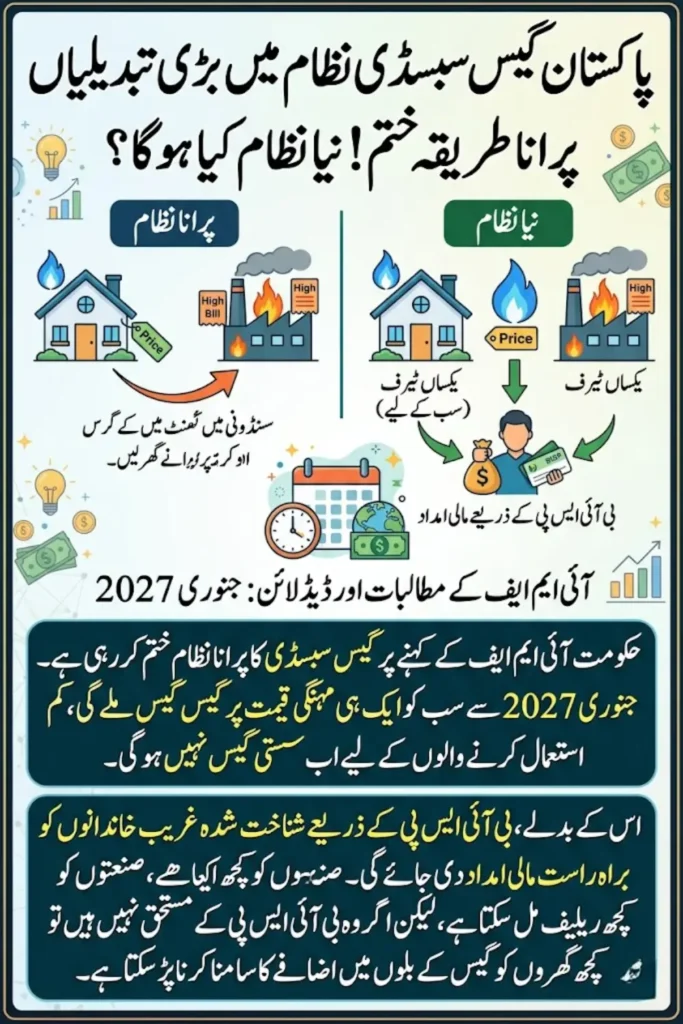
The government has now agreed to eliminate this mechanism and replace it with a uniform gas tariff for all consumers. Instead of receiving cheaper gas through lower slab rates, eligible households will receive direct financial assistance through BISP based on income verification rather than consumption levels.
Major proposed changes include:
- End of slab-based subsidized gas pricing
- Uniform gas tariff for all consumer categories
- Income-linked support through BISP
- Completion of reforms by January 2027
Government Plans Targeted Gas Relief Through BISP
The Benazir Income Support Programme will play a central role in the new subsidy structure. Under the proposed mechanism, low-income households that qualify through official income data will receive financial support directly instead of benefiting from reduced gas tariffs.
Officials believe this system will improve subsidy targeting by ensuring that only deserving households receive assistance. The government also aims to reduce inefficiencies in the current structure where subsidies are based on gas consumption instead of actual financial need.
The new BISP-linked support system may include:
- Income-based eligibility verification
- Direct financial assistance to low-income households
- Better targeting of subsidy benefits
- Reduced misuse of subsidized tariffs
You Can Also Read: Pakistan Receives $1.3 Billion IMF Loan After Successful EFF and RSF Reviews
Current Pakistan Gas Cross-Subsidy System Explained
At present, the Pakistan Gas Cross-Subsidy System is funded through higher gas charges imposed on industrial and commercial consumers. This means sectors such as export industries, CNG stations, cement manufacturers, and high-end domestic users pay increased tariffs to support lower-end consumers.
Officials clarified that the federal government does not directly finance these subsidies through the national budget. Instead, the subsidy burden is transferred to industries and commercial sectors through cross-subsidization mechanisms built into the gas tariff structure.
Sectors currently funding gas subsidies include:
- Captive power plants
- Export-oriented industries
- Commercial consumers
- CNG stations and cement sector
- High-end domestic users
| Sector Category | Current Role in Subsidy System |
|---|---|
| Protected Consumers | Receive subsidized gas rates |
| Industrial Sector | Pays higher tariffs |
| Commercial Consumers | Contribute through cross-subsidy |
| High-End Domestic Users | Pay increased gas charges |
Uniform Gas Tariff of Rs. 1,750 Per MMBtu Proposed
According to officials, all consumer categories are expected to pay the same average gas tariff once the new system is implemented. The current average gas tariff stands at Rs. 1,750 per MMBtu, which may become the standard rate for domestic, commercial, and industrial consumers alike.
This reform will effectively eliminate the existing difference between subsidized and non-subsidized consumers. While industries may experience some relief from the cross-subsidy burden, many domestic users could face higher gas bills if they no longer qualify for financial support under BISP.
Expected changes under the uniform tariff system include:
- Same gas tariff for all consumers
- End of protected consumer slab rates
- Reduced pricing distortions in the gas sector
- More transparent tariff structure
You Can Also Read: Rs. 700 Million e-Learn She Earn Program Launched by CM Maryam Nawaz in Punjab
IMF Energy Reforms and Government Commitments
Pakistan’s agreement with the IMF includes several energy sector reforms aimed at improving financial sustainability and reducing circular debt pressures. The Pakistan Gas Cross-Subsidy System reform is considered an important part of these broader commitments under the IMF program.
Officials believe the current pricing system creates distortions by placing excessive financial pressure on industries and commercial users. By shifting to targeted subsidies through BISP, the government hopes to improve efficiency while maintaining support for vulnerable households.
Main objectives of the reform include:
- Financial sustainability in the gas sector
- Reduction in pricing distortions
- Better subsidy targeting
- Improved transparency in tariff policies
Impact on Domestic Consumers and Industries
The new pricing structure may have different effects on various consumer categories. Industries and commercial sectors currently contributing to the subsidy burden could benefit from a reduction in cross-subsidy costs. However, some domestic consumers may experience higher gas bills once subsidized slab rates are removed.
Low-income households that qualify through BISP are expected to continue receiving financial assistance under the new framework. The government believes this approach will provide more accurate support to deserving families while reducing unnecessary subsidies.
Possible effects of the reform may include:
- Higher gas bills for some households
- Reduced financial pressure on industries
- Better-targeted welfare assistance
- More balanced gas pricing system
You Can Also Read: Oppo Find X10 Pro Max Leak Reveals Dual 200MP Cameras and 2nm Chipset
| Consumer Category | Current System | Proposed System |
|---|---|---|
| Protected Consumers | Lower slab rates | Uniform tariff with BISP support |
| Non-Protected Consumers | Partial subsidy benefit | Full average tariff |
| Industrial Consumers | Higher cross-subsidy charges | Reduced subsidy burden |
| Low-Income Households | Consumption-based relief | Income-based direct support |
Challenges in Implementing the New Gas Subsidy Model
Implementing the new Pakistan Gas Cross-Subsidy System reform may present several administrative and technical challenges. Accurate income verification and efficient distribution of financial support through BISP will be important for the success of the new framework.
There may also be public concerns regarding higher gas tariffs and increased household expenses. Experts believe careful planning, transparent communication, and effective data management will be necessary to ensure a smooth transition before the January 2027 deadline.
Key implementation challenges include:
- Identifying eligible households accurately
- Managing public concerns over tariff increases
- Ensuring transparent subsidy distribution
- Completing reforms within the IMF timeline
Future Outlook for Pakistan’s Gas Pricing System
The planned reforms represent a major shift in Pakistan’s gas pricing and subsidy framework. By replacing consumption-based subsidies with income-linked support, the government aims to create a more sustainable and transparent energy sector over the long term.
If implemented successfully, the new system could reduce distortions in gas pricing while improving financial management within the energy sector. However, the impact on domestic consumers and inflation will remain closely monitored as the transition process moves forward.
FAQs
What is the Pakistan Gas Cross-Subsidy System?
It is a pricing mechanism where industrial and commercial consumers pay higher gas tariffs to subsidize lower-income domestic users.
Why is the government ending the gas cross-subsidy system?
The government agreed with the IMF to replace the current system with targeted income-based financial support through BISP.
What will replace subsidized gas tariffs for protected consumers?
Eligible low-income households will receive direct financial assistance through the Benazir Income Support Programme.
What is the proposed uniform gas tariff?
The proposed average gas tariff for all consumers is Rs. 1,750 per MMBtu.
When will the new gas pricing system be implemented?
The government plans to complete the transition to the new system by January 2027.
You Can Also Read: IMF Pakistan Economic Forecast Revised as Growth Outlook Weakens for FY27