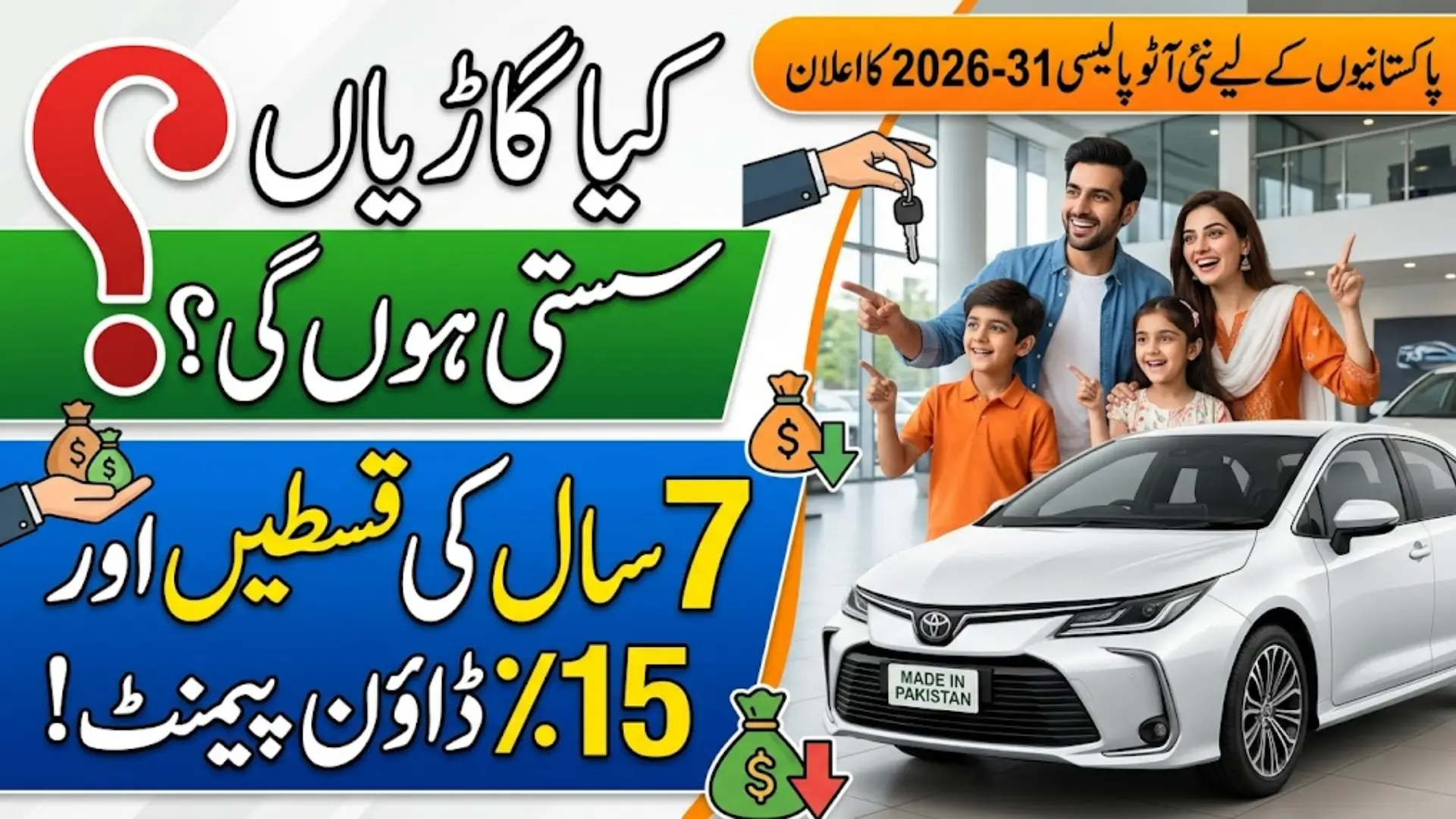
Pakistan Auto Policy 2026-31
The federal government is reviewing major reforms under the draft Pakistan Auto Policy 2026-31 to make vehicles more affordable and revive the country’s struggling automobile sector. The proposed Auto Industry Development & Export Policy (AIDEP) 2026-31 includes easier financing rules, reduced down payments, lower duties, and stronger support for electric vehicles and local manufacturing.
Government officials are currently discussing the proposals with the State Bank of Pakistan and industry stakeholders before final approval. The new policy framework is aimed at improving vehicle ownership opportunities, increasing local production, supporting exports, and encouraging consumers to choose locally assembled vehicles over imports.
You Can Also Read: Electricity Bill Taxes in Pakistan Reach Rs. 700 Billion in FY 2024-25
Pakistan Auto Policy 2026-31 Focuses on Easier Car Financing
One of the biggest proposals under the Pakistan Auto Policy 2026-31 is the introduction of easier car financing options for consumers. Authorities are considering extending vehicle financing tenure up to seven years, which would lower monthly installment costs and make cars more accessible for middle-income buyers.
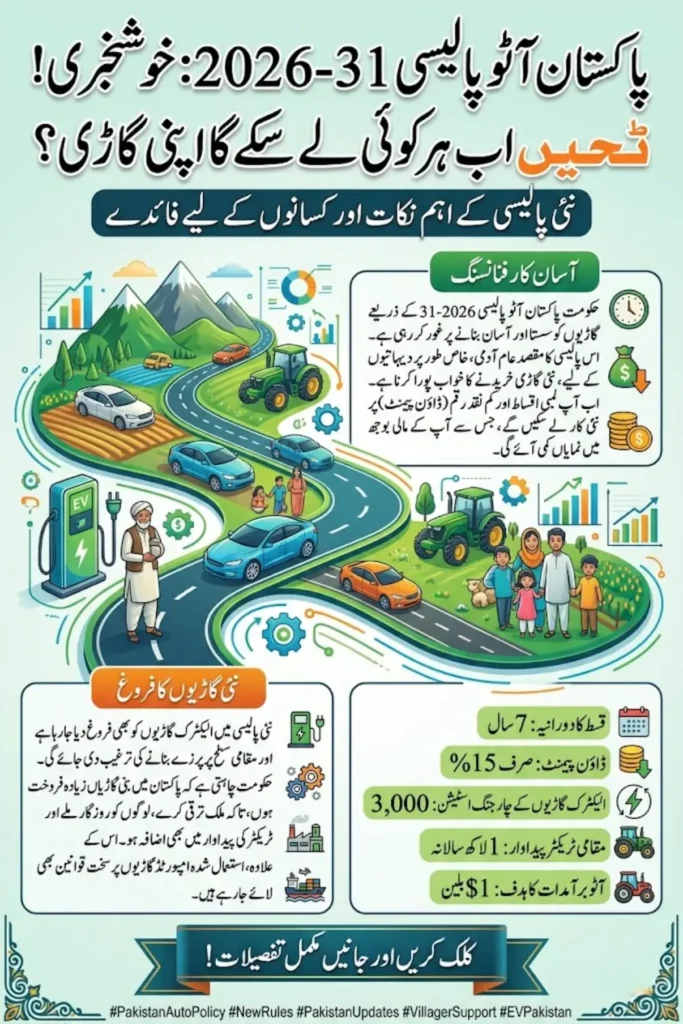
The draft policy also proposes reducing the minimum down payment requirement to 15 percent. In addition, a financing cap of up to Rs. 10 million may be introduced for eligible locally manufactured vehicles. These measures are designed to restore consumer purchasing power after years of high interest rates and rising vehicle prices.
Key financing reforms under discussion include:
- Car financing tenure extension up to seven years
- Minimum down payment reduced to 15 percent
- Financing cap of Rs. 10 million
- Support for locally manufactured vehicles
You Can Also Read: Car E Smart Card Online Registration Guide and Digital Vehicle Verification Benefits
Government Plans to Revive Pakistan’s Automobile Sector
Pakistan’s automobile industry has faced major challenges over the past few years due to inflation, high borrowing costs, and declining consumer demand. Vehicle sales dropped significantly as financing conditions became stricter and car prices continued to increase across all categories.
The Pakistan Auto Policy 2026-31 aims to stimulate demand and strengthen economic activity within the automobile sector. Easier financing can help improve sales while supporting local vendors, parts suppliers, and manufacturing companies connected with the industry. Officials believe these reforms can help stabilize the sector and encourage long-term growth.
The policy is expected to support:
- Increased vehicle sales
- Better industrial activity
- Growth in vendor industries
- Improved consumer confidence
Used Vehicle Imports to Become More Regulated
The draft policy also includes major changes for used vehicle imports in Pakistan. According to proposals under review, used car imports would move toward regulated liberalization with stricter compliance standards and inspection systems. Authorities want to ensure that imported vehicles meet quality and safety requirements.
The policy proposes reducing the tariff premium on imported vehicles from 40 percent to zero by FY2030. At the same time, imported vehicles would remain subject to certification, inspection, and compliance checks. A 30 percent depreciation cap is also being considered to regulate imported vehicle pricing.
Main proposals for imported vehicles include:
- Mandatory certification and inspection
- Compliance and safety verification
- Tariff premium reduction by FY2030
- 30 percent depreciation cap
You Can Also Read: IMF Pakistan Economic Forecast Revised as Growth Outlook Weakens for FY27
Consumer Protection Measures Under Pakistan Auto Policy 2026-31
The government is also focusing on stronger consumer protection rules under the proposed policy. Buyers often face problems related to delayed vehicle deliveries, changing booking prices, and expensive spare parts. The draft framework attempts to address these issues through new regulations.
Under the proposals, automakers may be required to maintain fixed booking prices and face penalties for delivery delays beyond 30 days. The policy also suggests limiting advance booking payments to 20 percent and capping spare parts markup at 20 percent at authorized dealerships. Warranty responsibilities would remain with OEMs and approved importers.
Consumer-friendly measures include:
- Fixed vehicle booking prices
- Penalties for delayed deliveries
- Advance payment cap of 20 percent
- Spare parts markup limit of 20 percent
| Proposed Consumer Reform | Expected Benefit |
|---|---|
| Fixed Booking Prices | Better price transparency |
| Delivery Delay Penalties | Faster vehicle deliveries |
| 20% Advance Payment Limit | Reduced financial burden |
| Warranty Responsibility | Improved customer support |
Pakistan Auto Policy 2026-31 Promotes Electric Vehicles
Electric vehicle development is another important part of the Pakistan Auto Policy 2026-31. The government plans to increase the share of New Energy Vehicles (NEVs) in the local market and improve EV infrastructure across the country. The draft policy sets a target of 30 percent NEV share in new vehicle sales by 2031.
Authorities also plan to establish 3,000 EV charging stations nationwide, including fast chargers and battery swap stations. Additional proposals include fixed commercial charging tariffs, viability gap funding, and mandatory installation of Level 3 chargers at selected fuel stations in every province.
The EV development plan includes:
- 3,000 EV charging stations by 2030
- Fast chargers and battery swap stations
- Incentives for NEV adoption
- Commercial charging tariff framework
You Can Also Read: Oppo Find X10 Pro Max Leak Reveals Dual 200MP Cameras and 2nm Chipset
Duty Reductions and Tariff Reforms Proposed
The Pakistan Auto Policy 2026-31 proposes several tariff and duty reforms to improve competition and vehicle affordability. Officials plan to phase out Additional Customs Duties by FY2029 and reduce Regulatory Duties by 80 percent by FY2030. These changes could help reduce vehicle costs over time.
The draft framework also proposes gradually lowering duties on Completely Built Units (CBUs) and Completely Knocked Down (CKD) kits. CKD duties for cars, SUVs, and minivans may be reduced from 30 percent to 20 percent over five years. The reforms are aimed at encouraging technological advancement and improving market competition.
Major tariff reforms include:
- Additional Customs Duties phased out by FY2029
- Regulatory Duties reduced by 80 percent
- Lower CBU duties for improved competition
- CKD duties reduced from 30 percent to 20 percent
| Duty Reform Proposal | Timeline |
|---|---|
| End of Additional Customs Duties | FY2029 |
| 80% Reduction in Regulatory Duties | FY2030 |
| Reduction in CKD Duties | Over Five Years |
| Lower Tariffs on CBUs | Gradual Implementation |
Localization and Domestic Value Addition Targets
The draft policy places strong emphasis on localization and domestic manufacturing. Domestic Value Addition (DVA) targets would become performance-linked and digitally verified through Pakistan Single Window (PSW). The government aims to increase local production capacity and reduce reliance on imports.
Under the proposed framework, cars below 1000cc would require 80 percent DVA by FY2031, while SUVs would need 55 percent local content. The policy also proposes 50 percent DVA for all NEVs and 85 percent DVA for two and three-wheeler electric vehicles.
Localization targets include:
- 80 percent DVA for cars below 1000cc
- 55 percent DVA for SUVs
- 50 percent DVA for NEVs
- 85 percent DVA for two and three-wheelers
You Can Also Read: Rs. 700 Million e-Learn She Earn Program Launched by CM Maryam Nawaz in Punjab
Major Targets Under Pakistan Auto Policy 2026-31
The government has set ambitious targets for the automobile sector under the proposed policy. These goals focus on increasing production, exports, localization, and electric vehicle adoption by 2031. Officials believe these targets can help transform Pakistan into a stronger regional automotive market.
The draft framework targets annual production of more than 500,000 vehicles and auto exports worth $1 billion by FY2031. It also aims to produce 100,000 tractors annually while expanding EV charging infrastructure nationwide.
| Sector Target | Goal by 2031 |
|---|---|
| Annual Vehicle Production | 500,000+ Units |
| Auto Exports | $1 Billion |
| NEV Share in New Sales | 30 Percent |
| Tractor Production | 100,000 Units |
| EV Charging Stations | 3,000 Stations |
Future Outlook for Pakistan’s Automobile Industry
The Pakistan Auto Policy 2026-31 could significantly reshape the country’s automobile sector if implemented successfully. Easier financing, lower duties, consumer protections, and EV incentives may improve market confidence and encourage higher vehicle sales over the coming years.
However, the proposals are still under review and require approval through regulatory and cabinet-level consultations. Industry experts believe that the final policy will play an important role in determining the future growth, competitiveness, and sustainability of Pakistan’s automobile market.
FAQs
What is Pakistan Auto Policy 2026-31?
Pakistan Auto Policy 2026-31 is a proposed government framework aimed at improving car affordability, financing, localization, and EV adoption.
What financing reforms are proposed under the new auto policy?
The policy proposes seven-year financing, a 15 percent down payment, and a Rs. 10 million financing cap for local vehicles.
How will the new policy support electric vehicles?
The government plans to establish 3,000 EV charging stations and introduce incentives for New Energy Vehicles.
Will vehicle import duties be reduced under the draft policy?
Yes, the policy proposes reducing Regulatory Duties and gradually lowering tariffs on imported vehicles and CKD kits.
What are the main production targets under Pakistan Auto Policy 2026-31?
The policy targets over 500,000 annual vehicle production and $1 billion in auto exports by 2031.
You Can Also Read: Pakistan Receives $1.3 Billion IMF Loan After Successful EFF and RSF Reviews